From Classroom to Contribution: How to Write for SchoolArts Magazine
If you've ever thought about submitting an article but weren't sure where to begin, this post provides a few tips to help you turn your classroom experience into a publishable article.
Share Your Stories
One of the biggest misconceptions about writing for a professional publication is that you need a groundbreaking idea. You don't.
Whether you've developed a lesson that consistently engages students, found a creative solution to a classroom challenge, or discovered a new approach that transformed your teaching, your experiences can help fellow educators. That's exactly what SchoolArts is looking for—practical, classroom-tested ideas written by art teachers for art teachers.
Some of the strongest articles begin with a simple question:
- What lesson really connected with my students?
- What challenge did I solve this year?
- What teaching strategy would I share with a colleague?
- What would I present at a conference session?
If you've said, "You know what worked really well?" you're already halfway to an article.
Write Like You Talk
The best articles don't sound like research papers.
Instead, write conversationally. Imagine you're sharing your experience with a fellow educator who wants to try your idea in their own classroom. Explain what inspired the lesson, how you implemented it, what students learned, and any adjustments you made along the way.
- As you write, focus on helping readers answer these questions:
- Why did this lesson matter?
- How did students respond?
- What should another teacher know before trying it?
- What made the experience successful?
Keep the Main Idea Clear
Compelling articles are concise, 800 words or fewer.
Before you start writing, identify the one big idea you want readers to remember. Everything in your article should support that central message. Follow a simple structure for example, something like this:
- Introduce the lesson, challenge, or idea.
- Explain the inspiration or context.
- Describe the process and student experience.
- Share outcomes, reflections, or tips for implementation.
A clear focus makes your article easier to write and easier to read.
Don't Forget the Photos
Strong visuals are an essential part of a successful submission.
SchoolArts requires at least four high-quality images of student artwork and/or the creative process. These photos help readers visualize your lesson and understand student outcomes. Captions should include information such as student names, grade levels, artwork titles, and brief descriptions. As you're teaching throughout the year, make it a habit to document lessons that show promise. You never know which project may become your next article.
Include Resources That Help
Think about what would make it easier for another teacher to implement your idea.
Helpful additions might include:
- Handouts
- Templates
- Resource links
- Videos
- Assessment tools
- Extension activities
These supporting materials add value to readers and strengthen your submission. When preparing your submission, include the National Visual Arts Standards that align with your lesson or instructional approach. This helps readers understand how your work supports broader learning goals and curriculum requirements.
Why Share Your Work?
Publishing is about more than adding a line to your résumé.
When you share your ideas, you're advocating for art education. You're contributing to a professional community that thrives on collaboration, innovation, and the exchange of practical classroom experiences. Your article may inspire another teacher to try something new, solve a problem, or rethink what's possible in their own art room.
Ready to Submit?
Prepare your manuscript, gather your images and permission forms, and upload your materials through the SchoolArts submission page. Accepted authors receive an honorarium and a complimentary SchoolArts subscription upon publication. Everyone benefits when teachers share what they're learning. Your next successful lesson could be exactly what another educator needs.
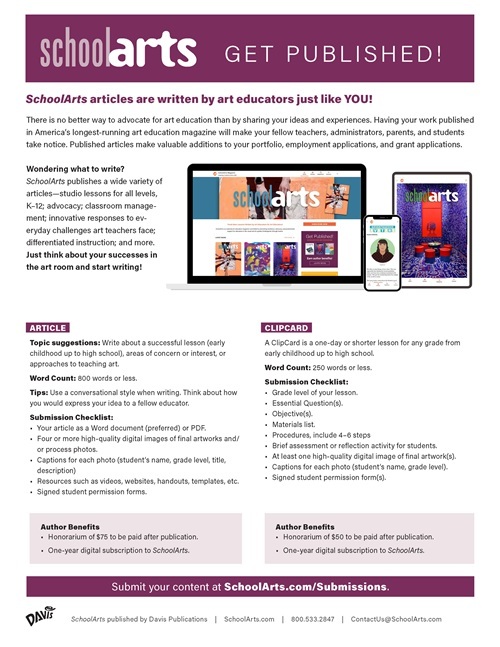
Every day, art educators create meaningful learning experiences for students. Those stories deserve to be shared. Learn more about writing for SchoolArts by downloading the Writer's Guideline's with the button below.
Looking for more information about getting published? Check out these additional resources:

Comments