Teaching with Inquiry in the Art Room
Where the Shift Begins
There’s a moment that happens in a lot of art rooms. You show an image, explain a concept, maybe demonstrate a technique, and then pause. Some students jump in. Others look back at you, waiting. Not stuck, exactly. Just unsure where their own thinking fits.
Now imagine shifting that moment just a little. Instead of beginning with an explanation, you begin with a question. What do you notice? What stands out? What do you think is going on here? At first, the answers might be simple. But then someone builds on an idea. Someone else disagrees. Another student points out something no one has mentioned yet. The conversation starts to take shape, and so does their engagement.

Starting with a Question
Inquiry works in that space.
It doesn’t require a complete overhaul of how you teach. In many ways, it’s just a subtle shift—from delivering information to uncovering it alongside your students. Instead of positioning yourself as the source of answers, you create opportunities for students to look closely, think deeply, and make meaning for themselves.
That shift can change how students see their role in the art room. They’re not just there to follow directions or replicate a result. They’re there to explore ideas, test possibilities, and figure out what they think.
What This Looks Like in Practice
This works at any level. A first grader might respond to a question by pointing out shapes and colors, making connections to their own experiences. A high school student might take that same starting point and move into interpretation, symbolism, or critique. The entry point is shared, but their thinking grows as they do.
In practice, inquiry can look a lot of different ways. It might be a short discussion before students begin working. It might show up in the way you introduce an artist, holding back context just long enough for students to form their own ideas first. This even shapes how learners reflect on their own work. Instead of asking “What did you make?” try “What were you hoping to communicate?”
With Davis Publications, this kind of thinking is built into the curriculum. Lessons are designed to prompt observation, spark questions, and support students as they develop both ideas and skills. You’re not left guessing how to guide the conversation; it’s woven into the structure.
When the Room Starts to Change
The goal isn’t just to get students making. It’s to get them thinking. When that happens, the dynamic in the room shifts. Students become more willing to share ideas, even unfinished ones. They take more ownership over their work. And over time, they begin to trust their own thinking in a way that carries beyond a single lesson.
You may still get questions. But they sound a little different. Not “Is this right?” but “What if I tried this instead?” That’s inquiry at work.
Learn more about using inquiry to maximize student engagement and success in our professional paper by Dr. Amy Pfeiler-Wunder, Davis contributor and Associate Dean for the College of Visual and Performing Arts, Kutztown University of Pennsylvania.
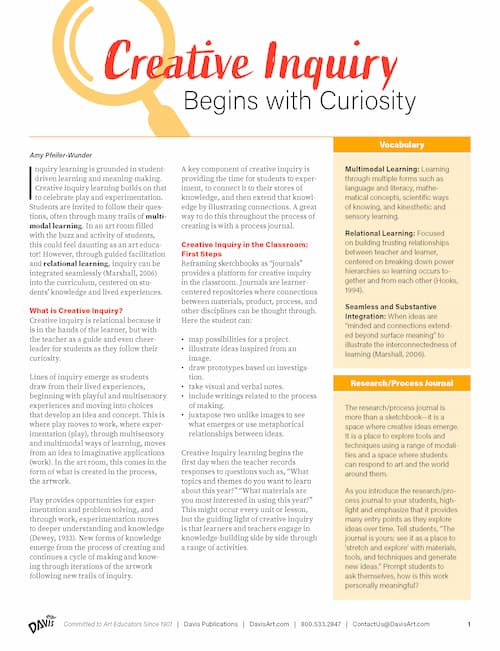
Download a printable PDF of the professional paper from Davis, Creative Inquiry Begins with Curiosity.
Resources
Looking for ways to bring more curiosity and conversation into your teaching? Check out these additional resources:
- Teaching through Inquiry Webinar
- Artmaking, Play, and Meaning Making
- Multi-Modal Learning through the Power of Play, K12ArtChat the podcast, Episode 221
- Modalities & Reimagining Materials through Inquiry, K12ArtChat the podcast, Episode 239
- K12 Curriculum & Resources to support teaching through inquiry

Comments