World Watercolor Month: Art by Lewis Lomay (Lomayesva, 1916-1996, Hopi Pueblo, Arizona)
I’m always a little sad when World Watercolor Month is over, because there are so many fantastic watercolors in the Davis collection that I want to show you! Lewis attended the Santa Fe School, a formal painting program established in Santa Fe, NM in 1932 which encouraged Pueblo artists to paint scenes of traditional Pueblo life without using any Western painting concepts such as perspective, perfect anatomy, or sculptural form.
World Watercolor Month is Coming to an End: Art by Lewis Lomay (Lomayesva, 1916-1996, Hopi Pueblo, Arizona)
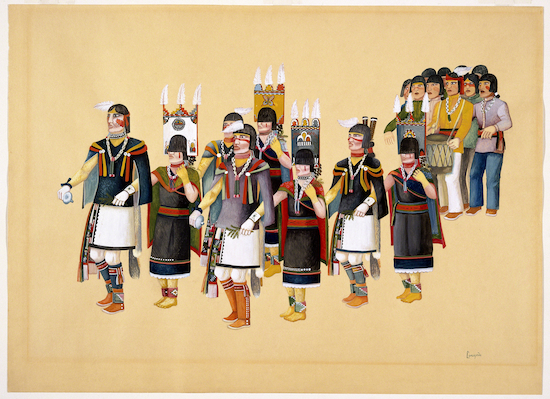 |
| Lewis Lomay (Lomayesva), Hopi Corn Dance, 1930s, watercolor on paper, 40.5 x 55.7 cm Brooklyn Museum, © 2026 Artist or Estate of Artist (BMA-4738) |
Lewis Lomay's work is very much in keeping with the Santa Fe Indian School style established in the 1930s. These artists used primarily watercolor or gouache. Typically in the scenes they depicted, the figures and ceremony were the sole focus of the work, existing on a blank background. Lomay was actually more renowned for his single-figure paintings of katsina. His work is especially appreciated for his incredible detail of costume and accoutrements.
The Hopi Corn Dance, called Qa'ö, is part of the historical dependence of the Hopi on dry-land corn farming. Used to agriculture in an arid atmosphere of northeastern Arizona, the Corn Dance occurs in the spring to encourage the growth of corn and occurrence of rain. Concurrent is the appearance of the Hopi Harvester, a katsina that represents the corn dancers. Corn Dancer Katsina (Ka-e or So'tungtaka) is the primary figure (in the front row) representing a prayer for the fruition of the crops. These katsina are often accompanied by female counterparts known as Manas (like the Poli Mana or Butterfly Maiden), who keep the rhythm. The masked women dancers in this scene are most likely representing either Butterfly Maidens or Corn Maidens.
Background
The Pueblo and Navajo cultures of the Southwest did not have a tradition of pictorial narrative art. However, during the first two decades of the 1900s, there was a concerted effort by well-meaning anthropologists and intellectuals to begin such a tradition for them. These thinkers believed that many traditions of First Nations life were vanishing and needed to be documented in pictorial form. Initially works were commissioned from several Hopi men for display outside the community starting in 1899. A few years later several other Pueblo artists began making paintings for sale to outsiders. By the late 1920s, many Pueblo artists were experimenting with painting and drawing scenes of traditional Pueblo life.
The pictorial movement got its greatest impetus from the establishment of a formal painting program at the Santa Fe Indian School in 1932. Non-native teacher Dorothy Dunn (1903-1991) established The Studio, a painting program for high school-aged students. Dunn did not teach Western painting concepts such as perspective, plasticity or composition, insisting that the students rely on traditional art of Pueblo cultures. The Studio School ultimately was characterized by a flat, stencil-like style with minimal backgrounds that stressed subject matter.
Lewis Lomay (Lomayesva) is known for jewelry of clean, modern design with a European influence, and paintings of katsina. He was born at Old Oraibi on Hopi’s Third Mesa and studied art at the Albuquerque Indian School. Around 1930 he transferred to Santa Fe Indian School where Dorothy Dunn was teaching the flat style of painting for which the School became known. Lomay’s interest in developing new styles met with Dunn’s disapproval so he switched to studying jewelry under Ambrose Roanhorse.
Later in the 1930s he quit the Studio School to work at Frank Patania’s Thunderbird Shop where he stayed for 13 years. Lomay worked in both the traditional style he learned at school, but also developed clean, modern designs inspired by Patania. After starting his own business, he entered his work in shows and immediately started winning awards. The accolades continued until his death, just before the 1996 Santa Fe Indian Market.
Correlation to Davis program: Davis Collections – The American Scene Between World Wars 1918-1940

Comments