
Artist Birthday: Don Eddy (born 1944 US)
Don Eddy’s complex, fascinating Photorealist paintings and prints can truly lead to many hours of discovery on close inspection. To say his discerning eye leads to incisive realism would be an understatement. And yes, I did have a pair of platform shoes like these in the 1970s.
Artist Birthday for 4 November: Don Eddy (born 1944 US)
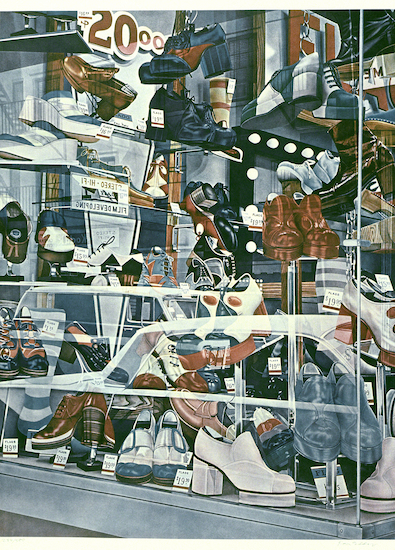 |
| Don Eddy, Untitled (New Shoes), ca. 1974, chromolithograph on paper, 84 x 66 cm Butler Institute of American Art, Youngstown, OH, © 2026 Don Eddy (BIAA-322)
|
From the cut-outs, Eddy developed an interest in highly realistic images that confronted the illusion of depth on a two-dimensional surface. He explored this successfully in numerous versions of store windows, such as this untitled piece, where both displayed objects and the reflected background vie for attention as subject matter. The result is a space made ambiguous by the reflections in the store window, implying space that would be behind the viewer.
Background
Throughout the history of art in the United States, there has been a visual fascination with material reality. The old love of realism in art were too deeply ingrained in the American public to completely die out even with the advent of Abstract Expressionism and Minimalism in the mid-1900s.
From mid-century to the present there have always been artists working with the recognizable figure. The most famous of movements to return to figuration was Pop Art in the late 1950s, and Photorealism of the 1960s. The movements themselves were a reaction to what was perceived as the domination of Abstract Expressionism in the art world in America.
Since then many artists continue to produce figurative work in a variety of styles. The Photorealism was celebrated with a major 1972 exhibition entitled "Sharp-Focus Realism," a show that included traditional, non-abstract and illusionistic work, many of which, like Richard Estes's (born 1932) work, resembled photographs.
Don Eddy grew up in California and studied fine art at the University of Hawaii, where Abstract Expressionism was taught as the “academic” style even though Pop Art was already challenging its primacy.
While growing up, Eddy worked in his father’s auto-body shop and became adept at matching colors when painting or repairing cars. He also painted surfboards and put various stains on furniture. His involvement with many different everyday objects informed his interest in them in his later painting.
Eddy’s earliest pieces were mixed-media works of wood, cast plaster, and oil paint that conveyed the influence of Pop Art, particularly the sculpture of Marisol (1930-2016) and the still-life series of Tom Wesselmann (1931-2004).
From these works, Eddy progressed to “cut-outs,” hard-edged, highly realistic paintings of irrationally juxtaposed forms that seemed to be influenced by the Surrealism of René Magritte (1898-1967). Like all Photorealists, Eddy rejected the Abstract Expressionist obsession with the personal nature of brushstrokes. Eddy continues to use an airbrush that he got when he was 13 while working in his father’s shop.
Correlation to Davis program: Davis Collections -- Still Life

Comments