
Artist Birthday: Joseph DeCamp (1858-1923 US)
Joseph DeCamp was one of “The Ten”, a group ten American painters who seceded from the National Academy of Art in New York over its refusal to exhibit American Impressionists’ artworks.
Artist Birthday for 5 November: Joseph DeCamp (1858-1923 US)
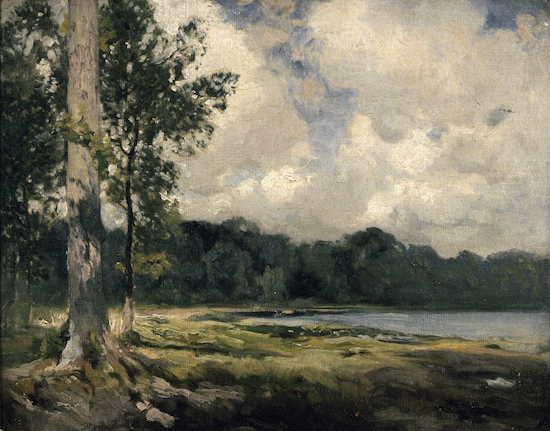 |
| Joseph DeCamp, Landscape, 1906, oil on academy board, 37 x 48 cm Photo courtesy of R.H. Love Gallery, Chicago, Image © 2026 Davis Art Images (8s-17165)
|
During summers DeCamp usually left Boston to sketch and paint outdoors. Landscape became an important part of his body of work, especially after 1886, the first of many summers he spent in Annisquam, near Gloucester, Massachusetts. While this work's palette is more akin to Duveneck's Dark Impressionist one, DeCamp painted it completely outdoors, as the Impressionists did. It may reflect the influence of the Barbizon school of landscape painters in France, whose inspiration ultimately was Dutch Baroque landscape painting, and who had recommended to the future Impressionists to paint outdoors.
Background
During the last half of the 1800s, painting in America was dominated by the Society of American Artists in New York City and the National Academy of Design. These institutions ruled the art world, and their juries decided who did and did not show at annual exhibitions, just as European academies did. Impressionism was artistically and aesthetically controversial when first exhibited in 1886 in New York, and not well-received by critics. By the time of the 1893 Chicago's Columbian Exposition, many American painters were working in Impressionist styles, although painting at the time was still dominated by the green-brown-yellow landscapes of the academic artists.
The conservatives who controlled the Society, however, prevented these artists from mounting exhibits which featured Impressionist paintings. Many critics considered Impressionism a fad which lacked the grandiose objectives of "true art". Such an attitude led these ten artists to resign from the Society and form their own "academy" of Impressionism, calling themselves The Ten. Those artists in the Society painted in more progressive, Impressionistic styles. They included Childe Hassam (1859-1935) Robert Reid (1862-1929), Frank Benson (1862-1951), Edmund Tarbell (1862-1938), Willard Metcalf (1858-1925), Joseph DeCamp (1858-1923), Julian Alden Weir (1852-1919), Thomas Wilmer Dewing (1851-1938) and Edward Simmons (1852-1931) who had all been in France. Hassam was the leader of this group of artists.
The first exhibition of The Ten together was March 30, 1898 at the Durand-Ruel Gallery in New York. That gallery had first introduced French Impressionist works to America and was known to favor avant-garde artists. The group was the first in America to organize outside of the official art academies.
Joseph DeCamp was born in Cincinnati. His interest in becoming an artists started when he was a teenager. His earliest painting training was at the McMicken School of Art and Design in Cincinnati, a conservative, academic institution. He also studied in Cincinnati under Dark Impressionist painter Frank Duveneck (1848-1919) whose style was influenced by the gestural, tenebristic (extremes in darks and lights) nature of Baroque painting. Through the 1880s DeCamp's style reflects Duveneck's influence.
Following Duveneck's lead, DeCamp went to Munich in 1878, and then followed him to Italy. Returning to the US in 1883, DeCamp secured a position as teacher at the Museum School of the Museum of Fine Arts in Boston. At the time, Boston was a center for American painters interested in Impressionism, and DeCamp soon incorporated those influences into his own work.
Correlation to Davis program: Explorations in Art 1E, grade 2, lessons 1.3 and 1.4

Comments