
Artist Birthday: Wendell Castle (1932-2018 US)
Wendell Castle was one of the pioneers of the American Studio Furniture/Woodworking movement that emerged after World War II (1939-1945). He is synonymous with finely crafted, unique furniture forms and sculptures in wood.
Artist Birthday for 6 November: Wendell Castle (1932-2018 US)
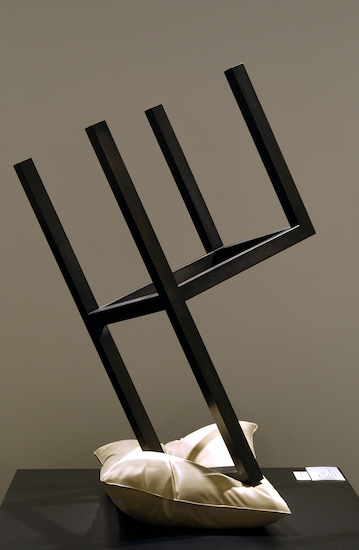
| Wendell Castle, Hanging in the Balance, 2002, Jelutong wood and bronze Spencer Museum of Art, University of Kansas, Lawrence (SMA-99)
|
Hanging in the Balance consists of an overturned bronze chair rests on a pillow molded from jelutong wood. The dark chair provides a stark contrast with the trompe l'oeil (fool the eye) beige pillow. Even in his furniture designs, Castle explored the differences between art and craft, form and function, and traditional perceptions of furniture.
In Hanging in the Balance, the artists was inspired by a magazine ad that featured a post wrapped in pillows, and he became fascinated with the way pillows give and wrinkle to harder objects. In this case, the pillow is the emphasis of the piece rather than the furniture, which is a traditional-looking type of side chair. Castle equates such illusionistic softness of the carved wooden "pillow" to the tradition of trompe l'oeil art.
Background
The history of furniture is defined by forms that have accommodated the human body through the many vicissitudes of fashion and what is fashionable, impacted also by concurrent trends in painting, sculpture and architecture. In essence, furniture is an excellent gauge of what has happened in history, socially, and artistically.
The rapid industrialization of Western Europe and the United States during the late 1800s and early 1900s had a major impact on, at first, the mass production of furniture, and later on the style of furniture. The combination of aesthetic integrity and industrial design that emerged in the early decades of the 1900s -- in such schools as the Bauhaus in Germany in 1919 -- engendered the reimagining of utilitarian (decorative) arts as fine art.
As the 1900s progressed, particularly after industrial and technological innovations emerged from World War II (1939-1945), furniture was less about the conformity the human body and to accepted (particularly the naggingly omnipresent historicist) styles, and more about being a reflection of a modern, industrial, progressive society that combined aesthetics with contemporary technological advances.
With that in mind, many furniture artists use their furniture designs in much the same ways as many contemporary painters or sculptors, as avenues of personal expression, regardless of what is the current trend.
Wendell Castle if credited with being one of the founders of the American Studio Furniture movement of the 1960s through the 1970s. This movement was a conscious effort on the part of furniture designers to eliminate the barriers to the perception of furniture as fine art.
Born in Kansas, he received a BFA in Industrial Design and an MFA in Sculpture from the University of Kansas. He subsequently taught at the Rochester Institute of Technology. He pioneered a sculpture technique of laminated, stacked wood which he then carved into organic forms. He transferred this interest in organic form to furniture design starting in the late 1960s.

Comments