Romance Awareness Month: Art by Pieter Brueghel, the Younger (1564-1637/1638 Flanders)
Genre and landscape became stand alone subject matter in the late Renaissance (ca. 1520-1600) and blossomed fully during the Baroque period (1600-1750). Pieter Brueghel, the Younger, emulated his famous father’s paintings, combining both genre and an impressive landscape. He copied his father’s Flemish middle class physical type, and structures in the landscape are vaguely similar to those of his father.
August is Romance Awareness Month: Art by Pieter Brueghel, the Younger (1564-1637/1638 Flanders)
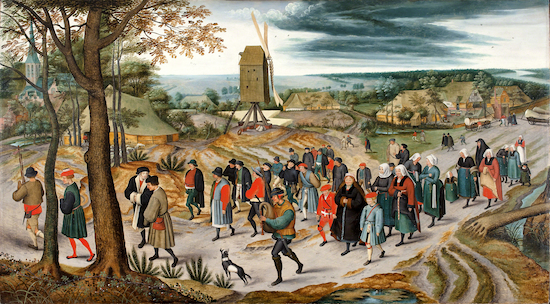 |
| Pieter Brueghel, the Younger, The Marriage Procession, 1623, oil on wood panel, 68 x 123 cm. Image © 2026 Worcester Art Museum, Massachusetts (WAM-42) |
The Marriage Procession was executed in the same spirit as his father's famous Peasant Wedding, and mirrors the Late Renaissance Flemish genre style. It depicts a country marriage attended by local rural folk and at least one bourgeois (middle class, in the black fur-lined coat) guest. While the bride is easily visible, Brueghel makes the groom less obvious, though he definitively marked him as the man on the left with the red cap and red tights with a wedding crown on top of his cap.
The younger Brueghel emulated his father's forms, but, the figures are flatter, and the lighting of the scene less atmospheric. The background too resembles the works of Brueghel's father. In the background is a scene of reapers, another typical motif of Brueghel's father, and a symbol of the transience of time, even for the happy couple.
The soaring landscape is executed in the colors typical for northern Renaissance works of the subject: warm colors in the foreground, green in the middleground, and blue in the distant background. Because there is no one point perspective obviously indicated, this recession into the distance keyed to color is known as atmospheric perspective.
Background
During the 1500s, some Italian artists rejected the restrictive classical canons of Renaissance painting that emphasized balance, geometric shapes, serenity and perfection of form. It was during the 1500s that increasing numbers of northern Renaissance painters went to Italy to study Italian styles in order to appeal to northern patrons with the most up-to-date trends. The Mannerist style transmitted to Flanders and the Netherlands from Italy is called Romanism for obvious reasons.
Similar in spirit to the rejection of Renaissance perfection in Mannerism, yet different in subject matter was the burgeoning discipline in northern painting of genre scenes. Genre scenes had started as drolleries (comical everyday scenes) in the borders of illuminated manuscripts. They then appeared in the background of northern religious painting, and gradually became an established subject matter. It was popular with the increasingly prosperous middle class, that had assumed almost an equal status to the nobility as art patrons.
Pieter Brueghel, the Younger was a pupil of the Romanist Gilles van Coninxloo (1544-1607), who applied Italianate principles to genre and also to the evolving genre of dedicated landscape. There is little to no influence of Coninxloo in Brueghel’s work. He was the son of Pieter Bruegel, the Elder (1525-1569), the artist who almost single-handedly elevated genre painting to the status it achieved. While he is most famous for copies he did of his father's encyclopedic paintings, he also distinguished himself in genre scenes of country people. His patrons were predominantly private, and he received no church commissions.
Correlation to Davis program: Discovering Art History 4E, lesson 2.1 Subject Matter: What is it Saying?

Comments