Artist Birthday: Auguste Rodin (1840-1917 France)
We all know the famous works by Rodin – The Thinker, and Burghers of Calais with their active surfaces and narrative. Rodin also had a lyrical side, one that came out in pieces like the praying hands Cathedral, or this beautiful portrait of his girlfriend Camille Claudel.
Artist Birthday for 12 November: Auguste Rodin (1840-1917 France)
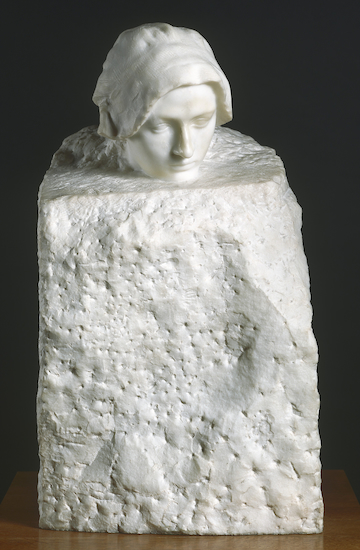 |
| Auguste Rodin, Thought, 1886-1889, marble, 74 x 43.1 x 46.1 cm Image © 2026 Philadelphia Museum of Art (PMA-2744)
|
Sometimes called Unfinished Portrait of Camille, Thought is a portrait of sculptor Camille Claudel (1864-1943). Claudel met Rodin at age 18, became his pupil, and subsequently his girlfriend until the mid-1890s. Meant originally to be a portrait of Claudel in traditional French regional costume, Rodin stopped at her collar.
Her finished head protruding from raw stone reminded the artist of the unfinished works of his hero Michelanglo (1475-1564), particularly the unfinished "slave" figures for Pope Leo's tomb. Like most of his even finished pieces, Rodin enjoyed contrasting textures in the same piece. Thought was first exhibited in the official Salon of 1895, where it was just titled Head, subsequently Thought Emerging from Matter, then just Thought.
Background
While it is true that Western European art was dominated by the all-powerful conservative Academies through most of the 1800s, the end of the century witnessed a rebellion against the outdated subject hierarchies, the entrenched insistence on classicism and idealization, and the overall rejection of emotional expression.
Inroads had been made, albeit within a classicist framework, by Romantic and Realist sculptors, but the majority of major public sculpture and architectural sculpture remained firmly rooted in the Academic tradition. Public sculpture would never be the same after the public commissions executed by Auguste Rodin in the 1880s.
Auguste Rodin was born in Paris the son of a police official. Although nothing in his family background suggested that he might become an artist, at the age of thirteen he enrolled in a free school for artisans in Paris. In the course of his studies Rodin decided that he wanted to be a sculptor. In his free time he studied great renowned works of sculpture at Paris’ biggest and most important museum, the Louvre.
Rodin failed to gain admittance to the most prestigious French art school, the The School of Fine Arts in Paris. Thus, during the 1860s, he worked as an assistant for the academic sculptor Albert Carrier-Belleuse (1824-1887) who produced works in a Neoclassical style. Between 1871 and 1874 Rodin worked on a commission in Brussels, Belgium where he learned how to manage a studio that produced large-scale public sculpture commissions.
Rodin travelled to Italy in 1876 where he was greatly impressed by the sculpture of ancient Greece and Rome, the Renaissance sculptor Donatello (c1386-1446) and by Michelangelo. What impressed Rodin the most about Michelangelo’s work was his depictions of muscles and anatomy. The perfection of the human, especially male, body in his sculptor would be a lifelong preoccupation for Rodin.
Unlike the Neoclassical sculptors who had dominated the medium with their interpretations of “ideal beauty,” Rodin felt that sculpture should express the natural physical realism of the human condition. He used his knowledge of anatomy and muscles to give his figures a realistic force absent from European sculpture for at least 150 years.

Comments