
Artist Birthday: Lisette Model (1901-1983 US, born Austria)
Lisette Model’s photographs of snooty, dressed up individuals – both male and female – caught in unguarded moments is the true genius of her photography. Her photographs strip away pretentiousness of any sort to reveal that – under fancy clothes and makeup – they are just human like everyone else.
Artist Birthday for 10 November: Lisette Model (1901-1983 US, born Austria)
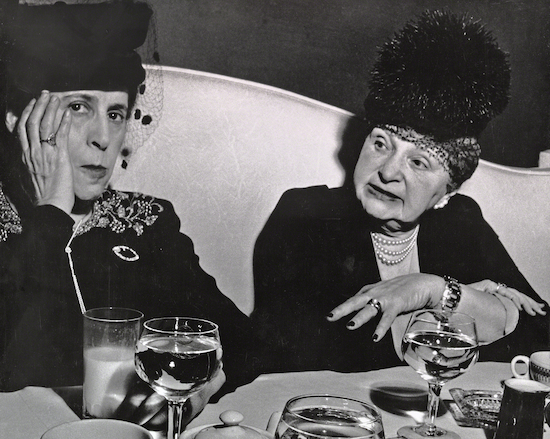 |
| Lisette Model, Fashion Show, Hotel Pierre, New York, 1943, gelatin silver print on paper, 50.5 x 40.5 cm The Museum of Modern Art, New York, © 2026 Estate of Lisette Model (MOMA-P3316) |
Model's photographic aesthetic was greatly influenced by the Expressionist avant-garde in the first half of the 1900s. She was interested in depicting every aspect of modern society, including the emotion, tension and anxiety of urban existence. The figures in her compositions greatly fill the picture plane, creating unflattering caricatures of her subjects. She was once advised not to photograph anything that did not "punch her in the stomach."
Model often photographed subjects in unguarded moments, stripping away elegance and laying bare the artifice associated with keeping up appearances. Her work is devoid of all extraneous devices or exaggerations, and the unsparing investigation of pretentious wealthy people dressed like peacocks in less than flattering attitudes was typical of Model's approach. Model’s approach to her subjects had a strong influence on Diane Arbus (1923-1971), who studied with Model when she taught at the New School for Social Research from 1951 until her death.
Background
By the 1930s, most photographers had embraced the idea that the camera had absolute objectivity. This objectivity was considered a unique property of photography, and its most valuable asset. After the Great Depression (1929-1940) and World War II (1939-1945), interest revived in straight photography.
Straight photography -- photography that emphasizes the camera's ability to produce images sharp in focus and rich in detail, usually of everyday subjects, without any manipulation in taking the image, in the darkroom, or with digital manipulation – became popular again in part because magazines such as Life and Look used photographs to record scenes of everyday life all over the world, news events, portraits of celebrities, and historical events.
Another influence on photographic style at the time was “snapshot” photography. Snapshot cameras were readily available to the general public as early as the 1930s. These cameras allowed amateurs to take spontaneous and unposed photographs giving a straight record of people or events.
Lisette Model was born Elise Stern into a well-off Jewish family in Vienna. She studied to be a pianist initially under avant-garde composer Arnold Schönberg (1874-1951), who also introduced her to his circle of avant-garde artist friends.
After her father’s death in 1924, her mother and sister moved to Nice, France in 1926 while she was attracted to the vibrant art community in Paris. In Paris she studied voice from a Polish soprano until 1933 when she abandoned music entirely for visual arts.
At first Model studied painting, but learned about photography from her sister Olga, who was a professional science photographer. She taught herself photography, and apprenticed with Bauhaus-trained photographer Florence Henri (1893-1982) in 1937. While visiting her mother in Nice, she became fascinated by the everyday people on the street and produced her Promenade des Anglais series of photographs. When Model and her husband emigrated to New York in 1938, her Promenade des Anglais photographs immediately established her reputation as an up and coming photographer.
By 1941, Model’s photographs had been exhibited at the Museum of Modern Art and she had joined the Photo League. Her photographs appeared in major magazines such as Harper’s Bazaar. After a brief stint in California in the late 1940s, Model returned to New York in 1951 and began teaching at the New School for Social Research where she taught until her death. She never stopped taking photographs, but by the mid-1970s she had stopped printing them.

Comments