Artist Birthday: Wilmer Jennings (1910-1990 US)
The Federal Arts Project of the WPA was a lifeline given artists during the Great Depression, and it benefited many African American artists like Wilmer Jennings, as well as promoting the art form of printmaking in a big way.
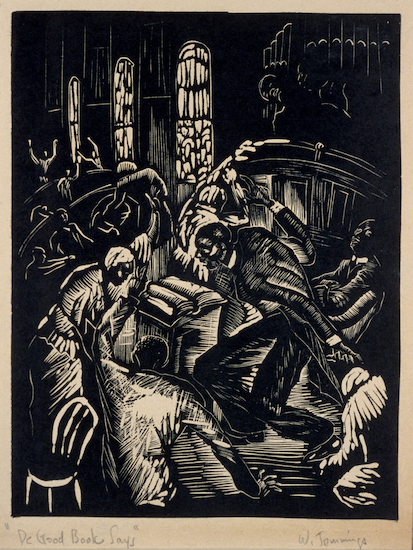 |
| Wilmer Jennings, De Good Book Says, ca. 1935, linoleum cut on paper, 25.4 x 20.3 cm Fisk University Museum, Nashville, TN, image from the landmark exhibition Two Centuries of Black American Art at the Los Angeles County Museum of Art, © 2026 Artist or Estate of Artist (8s-21919)
|
While working in the WPA, Jennings became interested in producing prints that depicted the lives of African Americans. De Good Book Says, based on a 1935 painting of the same subject, depicts the importance of the Christian religion in the African American community.
Jennings, however, chose to use exaggerated form, sharp angles and distorted figures to express the passion of the Black church. The exaggerated figures recall the work of Woodruff, as well as the Expressionist relief prints of the German Expressionists, about whom he had learned from Woodruff.
Background
The Great Depression (1929-1940) was a world-wide economic downturn. The ruined American economy had a chilling effect on artists. Happening as it did during the Harlem Renaissance, a flourishing of African American culture and art, it hit the black community especially hard.
Six years after the beginning of the Depression, the US government enacted the Works Progress Administration, an agency that found public service jobs for the unemployed. One component of the WPA was the Federal Art Project, which employed artists, both Black and white, to decorated government buildings with uplifting murals, teach community art programs, and create venues for art to be exhibited to the public.
Before the Depression, there were not large numbers of African American printmakers, but the Federal Arts Project changed that. Wilmer Jennings is one of the artists who benefited from the training in printmaking he received in the WPA.
Wilmer Jennings was born in Atlanta. He attended Moorehouse College in Atlanta, where he became acquainted with under avant-garde African American painter Hale Woodruff (1900-1980) of Atlanta University. Woodruff encouraged Jennings to study European modernism and incorporate it into themes about African American life. Hale and Jennings painted two murals together in Atlanta (later destroyed).
After graduating from Moorehouse, Jennings moved to Providence where he studied at the Rhode Island Institute of Design. In 1935 he became involved with the WPA's Federal Arts Project. There he gained valuable experience with printmaking techniques. He was particularly drawn to the relief processes of linoleum cut and wood engraving.
Correlation to Davis Program: Davis Collections -- African American Art, 1920-1945

Comments