
National Sports Day: art by George Catlin (1796-1872 US)
National Day Calendar® created National Sports Day to celebrate the fans, families, and athletes of all the sports as they spend quality time at athletic events. Native Americans had sports all their own before the arrival of the European settlers.
October 16 is National Sports Day: art by George Catlin (1796-1872 US)
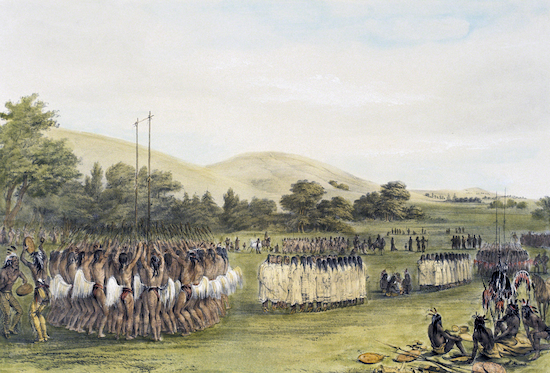 |
| George Catlin, Ball Playing Dance, 1844, hand-colored lithograph on paper, 41 x 57.8 cm © 2026 Butler Institute of American Art, Youngstown, Ohio (BIAA-357)
|
Plains Indians played a form of net-ball from which modern lacrosse has evolved. It was based on games played by the Sioux, the Onondaga, Ojibwe and Mohawk cultures. These games were semi-regular events between villages of often opposing cultures. The games could involve from 100 to 1000 male players at a time. The games were held as collective religious occasions, to settle inter-village disputes, and to toughen young men as warriors.
In 1834, Catlin witnessed Choctaw lacrosse in Indian Territory near present-day Oklahoma, and was fascinated by the game. The games, often held between multiple villages with sometimes dozens of men on each team, was a no-holds-barred struggle for the ball, a physical, even violent, game called “little brother of war” in Choctaw. The dance was held before the event to rev up the players, who were often young warriors honing their physical prowess.
Background
There was a steady push westward in the US after the Louisiana Purchase of 1803. Emboldened by their victories in the American Revolution (1775-1783) and War of 1812, Americans developed a certain presumption to their "God-given" right (so-called Manifest Destiny) in occupying the entire land stretching from the Atlantic to the Pacific of the North American continent below Canada and above Mexico.
The Indian Removal Act of 1830 basically gave settlers the right to any Indian lands east of the Mississippi in exchange for land (reservations) in the West. Even at this early point, there were artists who realized the unique culture of Native Americans and sought to document it in their art. Two of the earliest to do so were Charles Bird King (1785-1862) and George Catlin.
Born in Pennsylvania, Catlin grew up on farms in New York where he absorbed stories about Indians. Although he began a legal career at his father's urging, he abandoned it in 1821 to pursue a career as an artist. In 1828 he received the inspiration that guided his painting the rest of his life when he witnessed a visit to Philadelphia of a delegation of Indians from the West. He subsequently decided to devote his life documenting Indians, whom, he felt, had no biographers of their own.
Catlin is the first white artist credited with documenting Plains Indians in their natural setting. Between 1830 and 1836, Catlin traveled in the West from a base in Saint Louis, for five months out of each year, painting the lives of the natives.
From his travels he eventually produced over 600 paintings which he exhibited in his "North American Indian Gallery." In an effort to reap larger returns from exhibiting and enhance the gallery, improving chances for purchase by the federal government, Catlin issued a lithographic version of his paintings in the North American Indian Portfolio, published in London in 1844.
Correlation to Davis program: Experience Printmaking, Chapter 6 Lithography

Comments