Artist Birthday: Annibale Carracci (1560-1609 Italy)
Annibale Carracci was arguably one of the earliest Italian painters to create landscapes as stand-alone subject matter. Italian artists who painted dedicated landscapes lagged at least 100 years after German and Flemish Renaissance artists developed landscape as a stand-alone subject.
Artist Birthday for 3 November: Annibale Carracci (1560-1609 Italy)
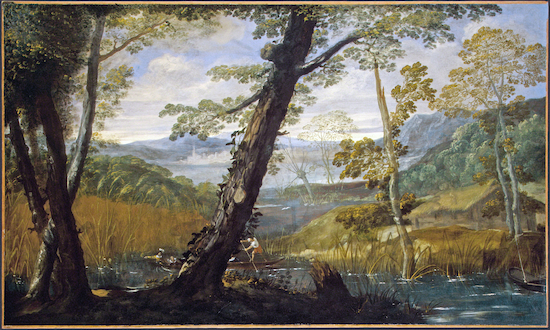 |
| Annibale Carracci, River Landscape, ca, 1590, oil on canvas, 88.3 x 148.1 cm Image © 2026 National Gallery of Art, Washington (NGA-P0262)
|
River Landscape was one of the first examples in Italy of the pure landscape. The style of this work, which is typical of Carracci's oeuvre is one of idealized realism with a highly organized structure underneath from which he never deviated. The landscape was composed and laid out in “layers” which extend to the horizon. It is a combination of knowledge of one-point perspective, and atmospheric perspective. Carracci’s landscapes established a repertory of motifs (such as the boat on the river in the foreground, the distant city, and even more distant mountains) that were to become standard in 1600s Italian landscape painting.
Such “classical”, peaceful landscapes had great impact on Baroque classicists of the 1600s, especially Claude Lorrain (1600-1682, France) and Nicolas Poussin (1594-1665, France), who were both directly influenced by Carracci’s landscapes. Carracci had the rare ability to combine the clarity and motifs of Classical painting with the exuberant appreciation of nature which was to characterize Baroque classicism and realism.
Background
The Late Renaissance (c1540-1600) style in painting was characterized in the work of many artists by conscious rejection of Renaissance principles of balance, symmetry and classical beauty. Figures became elongated, poses twisted, spatial relationships were distorted and often vague, and compositions were often asymmetrical and open. The style was known as Mannerism.
The Council of Trent was convened by the papacy 1554 to 1563 in order to correct the abuses by the Church which had led to the Protestant Reformation. The council also issued “standards” to combat the Mannerist style, which often depicted religious subjects in lewd or suggestive ways. The Church recommended that artists return to the “classicism” of the 1400s.
Annibale Carracci was a member of an influential family of Bolognese painters. Along with his brother Agostino (1557-1602) and his cousin Lodovico (1555-1619) he opened a painting academy in Bologna in 1585. The purpose of the school was to “reform” art, by retrieving the principles of such High Renaissance masters as Raphael (1483-1520) and Michelangelo (1475-1564).
Carracci decorated many palaces in both Bologna and Rome with fresco cycles in a conservative, classically influenced style. Carracci’s religious and mythological subjects were quite often set in landscapes which vied with the figures as the main subject matter. However, he was one of the first Italian artists to paint landscapes that stood on their own as subject matter. He had a true appreciation for nature, and made frequent trips into the country to make quick sketches. He then composed his landscapes in the studio by combining various elements from his sketches.
Correlation to Davis program: Explorations in Art 1E, grade 6, lessons 2.7 and 2.8

Comments