
National Older Americans Month: Art by Gilbert Stuart (1755-1828 US)
Older Americans Month was started in 1963 by President Kennedy as “Senior Citizens Month” to celebrate the achievements of older Americans, while emphasizing healthy living and activity choices. If anyone could endow a portrait of an older person with dignity and panache, it would be Gilbert Stuart. His portraits of the early American Republic are documents of quiet composure and strong personality, which one can see in the frank gaze of Mrs Yates.
May is National Older Americans Month: Art by Gilbert Stuart (1755-1828 US)
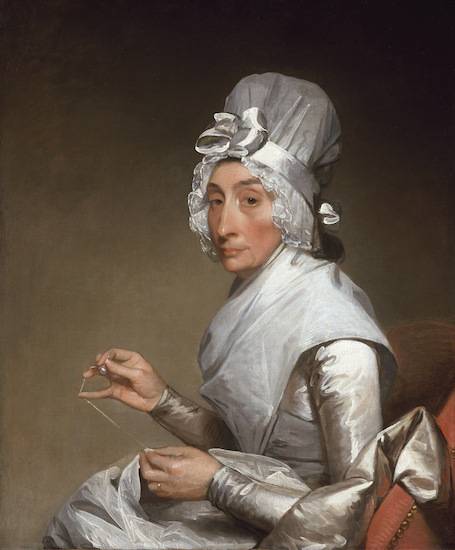 |
| Gilbert Stuart, Catherine Brass Yates (Mrs Richard Yates), 1793/1794, oil on canvas, 76.2 x 63.5 cm Image © 2026 National Gallery of Art, Washington (NGA-P0773)
|
Soon after his arrival back in the US in New York in 1793, Stuart painted Mrs Yates, a prosperous New York businessman's wife. Stuart's mastery of color expertly described the silvery hues of the woman's clothing in swiftly laid down painterly highlights, contrasting with the salmon tones of the skin that echo the color of the cushion of her chair.
Whereas Stuart's portraits of government personalities tended to involve surrounding backgrounds that established a gravitas and Grand Manner dignity, many of Stuart's private sitters are set against neutral backgrounds that establish an intimate connection with the sitter, particularly with their frank stare and painterly realism.
While British sitters expected flattery, even wealthy Americans desired an accurate, recognizable likeness. Her upright posture, industriousness in sewing, and stern uncompromising stare all perfectly reflect the unique pragmatism of early Americans which became a standard feature of American art during the early Republic.
Background
Art did not truly begin to flower in the American colonies until the early- to mid-1700s. During the 1600s and 1700s, painting consisted almost exclusively of portraits. In the earliest colonial painting, the colonists preferred a conservative painting style that reflected that of the Elizabethan (Renaissance) period in England, the primary subject matter of which was portraits.
After the American Revolution (1776-1783), the art of painting made great strides in expanding subject matter beyond portraits, and establishing an American style that was a unique blend of the Old World and the New. Instead of rejecting their European heritage, American artists conceived of American painting as a continuation of the same tradition, using American subject matter.
Many of the great portrait painters of the late 1700s had studied in England, and had adapted the Grand Manner to American portraiture, in a conscious decision to elevate American painting to the same level of academic "standards." They adroitly modified the American penchant for acutely observed, unvarnished realism with superficial trappings of classical antiquity and elements of Renaissance and Baroque art. American artists now had a story to tell about heroes, historical incidents and international figures in painting, in a way that taught moral, religious, or nationalistic lessons.
Born in Rhode Island, Gilbert Stuart first trained at the age of 14 with the itinerant Scottish portrait painter Cosmo Alexander (1724-1772). Alexander's style was typical of the reserved, moderately stylized realism characteristic of English portraiture. In 1772 Alexander took Stuart to Scotland, but died soon after, leaving Stuart stranded. He eventually returned to Newport and painted portraits in a naive, provincial style and realized that he needed training that was not available in the US.
Stuart went to London in 1777 where he came under the tutelage of expatriate American painter Benjamin West (1738-1820), one of the founders of the Royal Academy (1768), an avid believer in the supremacy of history painting and the Grand Manner style espoused by the Academy. Stuart quickly mastered the style, and his portraits took on the fluid, feathery, impressionistic brush work of English portraitists such as Reynolds, Romney and Gainsborough. In 1793 he moved back to America, first to New York, and in 1794 to Philadelphia.
Unlike many artists of the Grand Manner, Stuart eschewed history painting in favor of portraiture, because he could earn more money from rapidly producing portraits. He never had patience to begin with drawings for his portraits, and often finished the likeness of the sitter's face painting the likeness directly in a sketchy fashion in a single session of one or two hours. The slashing, painterly technique was so superb, that it conveyed an accurate, if not suggestive desired likeness. Thus, Stuart was able to produce a prodigious number of portraits in his career, including many of the important political and social leaders of the new country.

Comments