Labors of the Month, August: Pieter Bruegel (ca. 1525-1569 Flanders)
Paintings or manuscript illustrations of the “labors of the months” is an art subject that is as old as the hills, both Western and non-Western art. These cycles were meant to remind people of the “divine order” of the seasons for humankind, and so, presented what were considered typical activities each of the months. In many instances in art, the seasons were depicted alternating between activities of the “common folk”, and those of the elites. This series is called Months by Bruegel, but it actually chronicles the seasons, of which old timey times counted six. In it, the seasons are all represented (2 months at a time) by depictions of country people going about their labors.
Labors of the Months, August and September: Pieter Bruegel (ca. 1525-1569 Flanders)
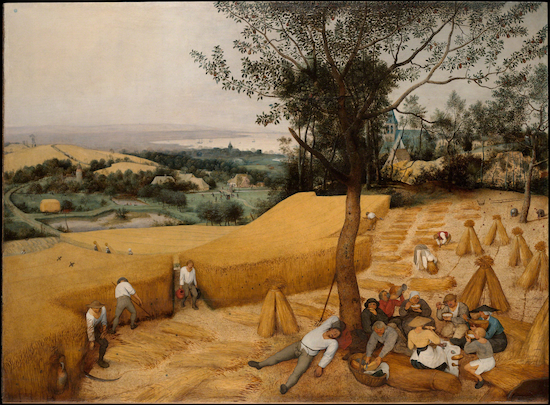 |
| Pieter Bruegel the Elder, The Harvesters, the months of August and September, from the series Months, 1565, oil on wood, 116.5 x 159.5 cm (45 7/8” x 62 13/16”) Image © 2026 The Metropolitan Museum of Art, New York (8s-30287)
|
Like many of Bruegel's works, this harvest scene is observed from a bird's eye view. The figures are anonymous, taken from carefully prepared sketches of local rural people. They are not presented as heroic tenders of nature, but rather simple human beings represented as a small part of the overall natural world, which was an on-going interest in Bruegel's works. Like the pioneering landscape backgrounds of early Northern Renaissance paintings, Bruegel has laid out the landscape in three layers, foreground in warm colors, middle ground in cooler colors, and distant background in the cool violets. The harvested hay is arranged in neat rows that help establish depth, while one harvester comes up an alley cut in the wheat presented in neat one-point perspective.
The series originally comprised six large-scale panel paintings, and Bruegel produced them for the country house of the merchant and collector Nicholaes Jongelinck; called ’t goed ter Beke (old Dutch for The Estate by the Stream), it was situated in the environs of Antwerp, and the paintings probably once adorned the dining room. Today, we would visualize the seasons in four paintings; in the 1500s in the Low Countries, however, the seasons were divided into six periods: in addition to autumn and winter there were early spring and spring, and early summer and late summer.
Background
The Late Renaissance (ca. 1540-1600) style in painting was characterized in the work of many artists throughout Europe by conscious rejection of Renaissance principles of balance, symmetry and classical beauty. Present day Holland, Belgium and Luxembourg (the "Low Countries") were occupied by the Spanish from the 1550s until the early 1700s, partly in order to restore the Roman dominance over religion after the Protestant Reformation, and partly to reap the taxes of the wealthy merchant class which ran the Low Countries. The Spanish occupation caused constant religious and secular uprisings and violence. In such a turbulent period, the interest in courtly style from Flanders and Burgundy waned in the Netherlands in favor of an accentuation of northern emphasis on physical realism.
Scholars generally agree that Pieter Bruegel was born near Breda (Holland on border with Belgium). He probably moved to Antwerp in the 1540s where he apprenticed to the painter/sculptor/tapestry artist Pieter Coeck van Aelst (1502-1550). Coeck's style generally fell into the Campin/Eyckian tradition of Flemish painting. Between 1552 and 1554 he traveled to Italy via Switzerland. He is thought to have spent a good deal of time in Switzerland because of the many sketches he produced of Swiss mountains.
On his return to Antwerp (1554/1555), Bruegel was first engaged in producing designs for engravings for the engraver/publisher Hieronymus Cock (1510-1570). His series on The Seven Deadly Sins and Big Fish Eat Little Fish were so successful, that Cock soon engaged him to produce figurative subjects. He also produced designs for engravings featuring alpine scenes from his Swiss studies. For the remainder of his career he was both a painter and printmaker.
Bruegel is famous for his "encyclopedic" works of the late 1550s such as Children's Games, Battle Between Carnival and Lent, and Netherlandish Proverbs in which he featured hundreds of figures engaged in typical bourgeois circumstances. After his marriage to Pieter Coeck's daughter in 1563, Bruegel's paintings became increasingly impacted by Italian Renaissance art with more attention to monumental forms than narrative. This is evident in such works as Peasant Wedding Feast, The Peasant Dance, and The Farmer and the Birdnester.
However monumental his figures became, his reliance on basing his figures on humble Flemish people and their activities did not jibe with Italian Renaissance ideals that dominated European art during the 1500s. After his death his works did not have a large following outside of the painters in his family. They did, though, become the object of much admiration and revisionist art history during the mid-1800s with the Realist artists who emphasized subjects of the rural poor.
Correlations to Davis programs: Explorations in Art 2E grade 1, lessons 4.4, 4.5, 6.1; Explorations in Art 2E grade 2, lessons 1.7, 3.8; Explorations in Art 2E grade 3, lessons 4.1, 4.3, 5.5; Explorations in Art 2E grade 4, lessons 3.1, 3.2; Explorations in Art 2E grade 6, 2.1, 2.2; The Visual Experience 4E lesson 8.13; Experience Art lesson 2.1; A Global Pursuit 2E lesson 4.2; Exploring Painting 3E pp. 154-166; Discovering Art History 4E, lesson 10.1; Exploring Painting 3E pp. 154-166; Exploring Visual Design 5E lesson 12.4

Comments