World Calligraphy Day: Art by Mughal Artist
As a person who was taught cursive writing in grade school, and who everyday writes in cursive to present my blogs, articles, and art historical content, I can vouch that I am a full-on calligraphy Lover! If we can call a beautiful plate of food in a gourmet restaurant a “work of art,” then I’m 100 percent behind calling beautiful handwriting – i.e. calligraphy – an art form!
12 August is World Calligraphy Day: Art by Mughal Artist
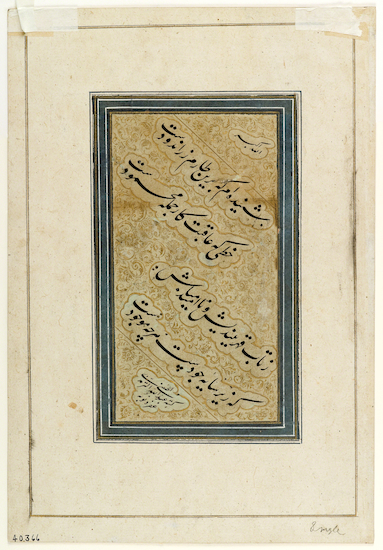 |
| India, Mughal Empire, Page of nasta’liq script from an unidentified manuscript, 1700s/1800s, ink, watercolor and gold leafg on paper. 48.5 x 37.8 cm © 2026 Brooklyn Museum (BMA-4465B)
|
This painted page contains nasta'liq calligraphy. The page displays the principle of approximate symmetry where each side does not mirror exactly the other, but the elements are similar enough to create visual symmetry. The shapes and colors of the background flowers help unify the page, while the variety of the different types of flora give the page an exciting decorativeness. Bookarts like this were produced by Iranian artists in the Mughal court, who were in turn influenced by western European manuscript illumination.
There were several types of Arab calligraphy. Nasta'liq developed in Iran in the 1300s and 1400s. It was a combination of two other Arabic scripts: ta’liq and naskh. It is the most fluid and expressive of the Arabic scripts, and is used extensively in copying romantic and mystical epics in Persian. Nasta'liq is still the preferred script used in Persian and Urdu.
Background
The importance of writing, which is emphasized throughout the Islamic holy book, led to the importance of calligraphy as an art form. Islamic book arts—calligraphy, illustration, and binding—matured during the middle period (750-1258). In the early period the Qu'ran seems to have been the most common book to be produced and decorated.
During the middle period, a variety of books were produced, due largely to the fact that paper became more available, replacing parchment as the major medium for writing and illustration. Books began to be decorated for scientific works, romances, histories, and epic and lyric poetry compilations. Because of the almost total lack of interest in panel painting in Islamic lands, books became a major form of artistic expression.
Calligraphers and illuminators were highly respected; their workshops were often sponsored by princes or courts. Because paper was cheaper than parchment, it meant that more people were able to buy books. Compared to Western Europe at the time, the rate of literacy in Muslim countries was very high.
In 1526 the Turk/Mongol leader Babur (1483-1530) founded the Mughal Empire when he invaded and conquered northern India (including Pakistan). Under Babur’s successors, especially the emperor Akbar (1542-1605), the empire grew to encompass three-quarters of the Indian subcontinent.
Islamic book arts in Mughal India were reinvigorated in the 1500s by Iranian artists who migrated to India when interest in painting and calligraphy waned in the Safavid court. The greatest flowering in Indian book arts came during the reign of Akbar a great patron of the arts, when the number of court artists swelled to one hundred.

Comments