
Artist Birthday: Dwight Tryon (1849-1925 US)
The Tonalism movement in painting was a late 1800s style which approximated some of the goals of Impressionism, but was more about filmy form and atmospheric precision. Dwight Tryon’s misty landscapes certainly stand up well in comparison to the works of more famous Tonalist artists such as James A.M. Whistler (1834-1903).
Artist Birthday for 13 August: Dwight Tryon (1849-1925 US)
|
||
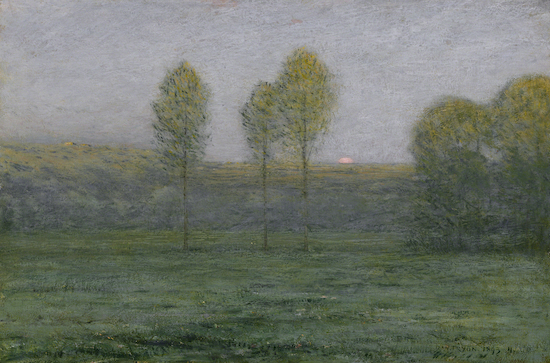
Tryon’s paintings typically feature a broken row or group of trees in front of a lustrous sky at sunset or sunrise with a marsh or pasture in the foreground, painted in muted autumnal hues. In Twilight Tryon depicts a wooded meadow veiled in the misty atmosphere of deepening twilight, dominated by muted grays, browns, and blues. The work clearly illustrates the influence the French Barbizon style of painting had on his work, with its emphasis on rural scenes drawn directly from nature accentuated by a sense of mood and shadow. Although his Tonalist works do not display the bright, pure colors of Impressionism, Tryon's misty landscapes come very close to the broken color technique of the Impressionists.
Background
There was no formal academic training system for artists in America until the 1800s. The American Academy of Design, founded in New York in 1825, and the Pennsylvania Academy of Fine Arts, founded in 1805 were the two main art schools in the US until later in the century (after the Civil War 1861-1865). These early academies stressed a rigid, conservative, and classicist curriculum, based on institutions in Europe such as London, Munich, Paris, and Rome. For the first half of that century, most artists who sought broader training in painting were advised to see their forebearers in Britain with its Royal Academy in London that had been established in 1768.
After the Civil War, an increasing number of American artists traveled to Europe to broaden their training. Instead of most of them going to Britain, many of them went to schools in Germany and France where they were exposed to styles other than Neoclassicism and Romantic Realism which dominated British art. In Germany American painters learned of styles now called Dark Impressionism which were based on the influence of Spanish and Dutch Baroque painting, involving fluid, gestural brushwork and extreme contrasts in dark and light (“tenebrism”).
Of the many American painters who went to Paris, a great many of them were influenced by Impressionism. However, others were influenced by the painters of the Barbizon School, a realist landscape group of artists who worked in soft tonalities, close color harmonies in bright colors, and subject composition arrangement. Like the Hudson River School, the landscape painters who emerged in this style called Tonalism believed that their close color harmonies, fuzzy forms and rearranged elements of the observed world could reveal the symbolic potential of landscape painting.
Dwight Tryon was born in Hartford, Connecticut. As a child he was strongly attracted to drawing. Most of his subjects were buildings in his neighborhood or boats on the Connecticut River. Working in a bookstore in Hartford as a young man, he gave it up to pursue a career as an artist in 1873. He supported himself as an artist giving painting and drawing lessons.
In the mid-1870s, Tryon became aware of contemporary painting abroad, and realized the shortcomings of his uninspiring landscapes of Connecticut. In 1876 he went to France, and received an academic training in Paris. Although Impressionism was in its ascendancy as the "latest thing" in painting, Tryon preferred the Realist landscapes of the Barbizon painters . When he returned to the US in 1881, he added the atmospheric emphasis of the nascent Tonalism movement.
Tryon had studios in New York and South Dartmouth, Mass. He taught painting for many years at Smith College in Northampton, Mass. With the advent of Post-Impressionism and its various modernist offshoots in the early 1900s, Tryon's Tonalist landscapes fell out of favor. His lasting legacy was the many students in whom he instilled his love of nature and art.

Comments