National Native American Heritage Month, art by Ojibwa Culture
Beadwork is one of the most distinctive characteristics of Ojibwa artistic expression. Before European contact, Ojibwe women decorated clothing and regalia with shells, dyed porcupine quills, bird quills, bone, seeds, and paint. The techniques were sophisticated.
November is National Native American Heritage Month, art by Ojibwa Culture
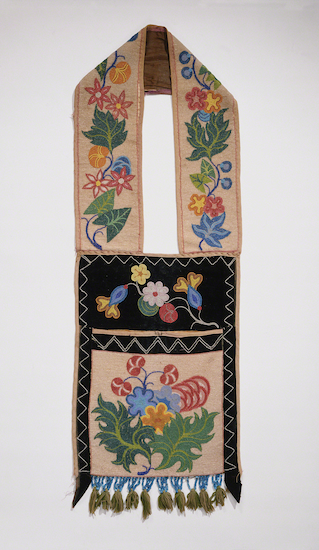 |
| Ojibwa Culture, Bandolier Bag, late 1800s-early 1900s, from the Eastern Woodlands or Northern Plains, cotton velveteen, printed cotton twill, cotton plain weave, glass beads, wool braid, wool yarn, 109.9 x 38.1 cm © 2026 Philadelphia Museum of Art (PMA-9321) |
The fur trade (with French settlers) transformed this tradition. Glass beads, introduced to the Ojibwa in the 1600s, revolutionized their decorative arts. Most glass beads used in the fur trade were made in Murano, near Venice, Italy, with other bead making centers in Holland and Bohemia. These vibrant trade goods replaced quill work and natural materials, allowing artists to create increasingly intricate designs.
Beautifully decorated bandolier bags are a typical art form of many Woodlands bands, particularly among the Ojibwa and Potowatami. The bandolier bag is worn over the shoulder and across the chest. The bags, which are made by Ojibwa women, can take up to a year to complete. They are made to honor the deeds of certain members of the band who are related to the midewewin, or “great medicine society.”
Traditionally the bags were used to carry personal possessions and food for journeys. The simple act of wearing such a beautifully decorated bag was a badge of honor for the wearer. Although they were originally intended to be carried exclusively by men, women occasionally wore the bag for a brother, husband, or son who had died, or in the place of a man who needed healing.
Among the Woodlands bands, traditional beads were made from shell. The beads of this bag are glass beads, which became readily available to First Nations from white settlers. Traditionally the bags were decorated with geometric patterns. Artists who created abstracted floral patterns such as this one were influenced by European and American styles.
Background
The Ojibwa (Ojibwe or Chippewa) is the largest group of First Nations people north of Mexico, and the third largest in the United States. They are equally divided between the US and Canada. The Ojibwa traveled widely across the continent for thousands of years. Eventually they began to migrate west along the Saint Lawrence River to the Great Lakes. The western group of the Ojibwa gradually expanded to the southern shore of Lake Superior. This group is called the Plains Ojibwa.
First historical contact with European settlers was the French traders in 1640. By the end of the 1700s, the Ojibwa were unchallenged “owners” of almost all of present-day Michigan, northern Wisconsin, Minnesota, and the entire north shores of Lakes Huron and Superior. Today over 100,000 are living in land from Michigan to Montana, and from western Québec to eastern British Columbia. They were traditionally know for artwork in birch bark, cowrie shells, wild rice and copper points.
Correlations to Davis programs: A Community Connection 2E, lesson 9.5; A Global Pursuit 2E lesson 2.5; Experience Art lesson 8.2; Discovering Art History 4E lesson 4.10

Comments