Beauty Attack: art by Tokumaru Kyoko (born 1963 Japan)
I “suffer” from constant Beauty Attacks, as you well know. One of the art forms that causes such frequent “events” is beautiful ceramic arts. Ceramics – basically earthenware – were produced in Japan earlier than any other culture on earth by the Neolithic Jomon Culture which lasted roughly 10,000-300 BCE. It is no wonder why the Japanese have established the honor called Living National Treasure which has been bestowed on many ceramic artists. Having seen the work of ceramic artist Kyoko Tokumaru, I am betting in the near future she will receive that honor --- her work is absolutely Stunning!
Beauty Attack for Curator's Corner 23 November: Tokumaru Kyoko (born 1963 Japan)
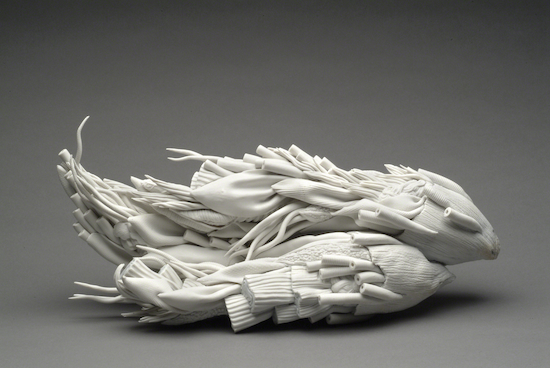 |
| Tokumaru Kyoko, Germination, 2001, earthenware, 22.9 x 53.3 cm (9” x 21”) Philadelphia Museum of Art, © 2026 Kyoko Tokumaru (PMA-9545)
|
Tokumaru's organic sculptural forms have been expressed in numerous iterations of the subject of Germinations (growth of a seed into a seedling). This work has intimations of examples of growth, with roots, a trunk, and branches, symbols of the universal, cosmic tree, the three parts representing the underworld, earth, and sky.
The work, part of her Cosmic Plants series, is based on the botanical form of an underground stem that puts out lateral shoots and roots at intervals (a "rhizome"). Many of the forms in Germination are based on molds made from such found objects as plastic tubes and pieces of discarded materials, all meticulously assembled into a whole that is both naturalistic and yet otherworldly.
Background
Artists of the Jomon Period in Japan (ca. 3000-200 BCE), produced some of the oldest extent utilitarian ceramic forms that had decoration for aesthetic rather than functional reasons. Ceramic arts have traditionally been considered "fine art" in Japan, much in contrast to the western perception of "decorative arts." The flowering of the tea ceremony in Japan during the Muromachi Period (1392-1573) with its important component of flower arranging cemented the honored place ceramics has long held in Japanese art.
In the early 1900s, inspired by the British Arts and Crafts Movement, reacting against the rapid "westernization" and industrialization of Japan, a group of ceramic artists founded the Japanese Folk Art Association, which fostered the idea of the studio ceramic artist, one who actively participates in every aspect of ceramic making.
The need to restore national identity after the disaster of World War II (1939-1945) helped strengthen the movement to fortify traditional art forms. At the same time, many younger Japanese artists, rejecting the strictures of traditional Japanese art forms, sought inspiration from Western art as Japan rapidly became part of the modern world.
Western inspired artists emerged in Japan during the same period in America, the late 1940s and 1950s, when the perception of ceramics transcended from merely utilitarian arts to fine art. An example of this would be the work of the American artist Peter Voulkos (1924-2002). Like Voulkos, the pioneering modern ceramic artist Yagi used traditional Japanese ceramic forms, and the traditional respect for the medium, as a jumping off point to introduce uniquely modern ceramic art.
Kyoko Tokumaru is a ceramic artist who creates highly detailed, natural-looking sculpture out of porcelain, grounded in the traditional coiling method. Born in Tokyo, she received both BFA and MFA (1992) in ceramics from Tama University. The undulating, twisting forms impart a weightless, almost underwater floating look to her works that does not give the impression of the brittle, hard quality of high-fired porcelain.
Her exuberant pieces often contain parts that are cast from rubbish she finds, and then are manipulated to serve the composition. She says that a major influence on her forms are the floral offerings and decorations found in Japanese temples, which she equates with the prayers and magic inherent in the human race.
Correlation to Davis programs: Explorations in Art 2E grade 1, lesson 4.9; Explorations in Art 2E grade 3, lesson 2.3; Explorations in Art 2E grade 4, lesson 6.2; Explorations in Art 2E grade 6, lessons 2.5, 2.6; A Global Pursuit 2E lesson 7.5 studio time; A Personal Journey 2E, p. 259 studio time; The Visual Experience 4E, lessons 10.5, 10.13; Experience Clay 3E, p. 122; Exploring Visual Design 5E, lesson 6.3; Davis Collections -- Women Artists 2000s

Comments