
Artist Birthday: Stefano Boeri (born 1956 Italy)
The architectural designs of Stefano Boeri are truly inspiring and pioneering in green architecture. Boeri’s green designs have appeared all over Europe and in China, setting an example for how human beings can continue to wisely exist on this fragile planet.
Artist Birthday for 25 November: Stefano Boeri (born 1956 Italy)
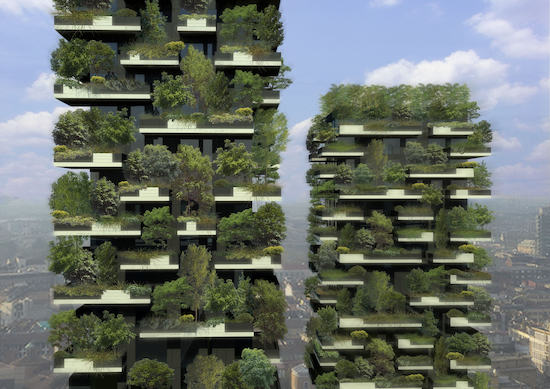 |
| Stefano Boeri, Vertical Forest (Bosco Verticale), Milan, Italy, 2007-2013 Image © 2026 Stefano Boeri / Davis Art Images (DAH-1641)
|
The work of Stefano Boeri can be described as a hybrid of Land Art and architecture. Bosco Verticale (Vertical Forest) is the result of an attempt by the city of Milan to reclaim a portion of one of the most industrialized and polluted cities in the world. More than 1500 trees grow in the twin residential high-rises.
Trees, bushes, and more than 11,000 plants grown on the stepped terraces. They are watered with grey water from the sinks and showers in the building. The biomass (infinite source of organic material that comes from plants and animals) of Bosco Verticale is the equivalent of 2.5 acres, or 10,000 square meters (107,000 square feet).
The plantings provide shade in summer and insulation in winter. Boeri has planned many projects that transform cities into nature-friendly urban spaces, including another Bosco Verticale in Lausanne, Switzerland.
Background
The architect and urban planner Stefano Boeri has dedicated his career to designing green architecture. He received an MA from the Polytechnic University of Milan and a PhD from the IUAV University in Venice. In 1993, he founded the research entity, Multiplicity, where research is conducted on the relationship between contemporary urban sprawl, architecture, and indigenous culture. He established Boeri Studio in 1999 in Milan, which evolved into Stefano Boeri Architetti ten years later.
Boeri focuses on the design of green building design in urban areas that require redevelopment and natural regeneration. His plans include research into the architectural needs, a detailed examination of the natural surroundings, and architectural elements that promote nature-responsible social behavior.
It wasn’t until the mid-1900s that architects became more conscious of the impact construction has on the earth's biosphere, and began to explore nature-aware designs. Today, concern for human beings’ impact on the fragile biosphere is at the forefront of architectural design, with an emphasis on recycling, solar energy, and maintainable resources.
Architecture in the 2000s, like architecture in the 1960s, reflects the architects’ personal signature style in ways that are organic, geometric, or a combination of both.
Correlations to Davis programs: Explorations in Art 1E grade 5, lessons 2.11 and 2.12; A Community Connection 2E lesson 9.1; The Visual Experience 3E, lesson 11.5; Experience Art lesson 1.5; Exploring Visual Design 4E, Chapter 8 Unity; Davis Collections -- STEAM: Science; Davis Collections -- Land Art

Comments