Artist Birthday: Antonius Bernardus "Toon" Kelder (1894-1973 Netherlands)
Toon Kelder was an example of the richness of modernist experiment in Dutch art of the early 1900s. Resisting the domination of De Stijl with its insistence of geometry and primary colors, Kelder plowed his own course in abstraction to great success.
Artist Birthday for 24 November: Antonius Bernardus “Toon” Kelder (1894-1973 Netherlands)
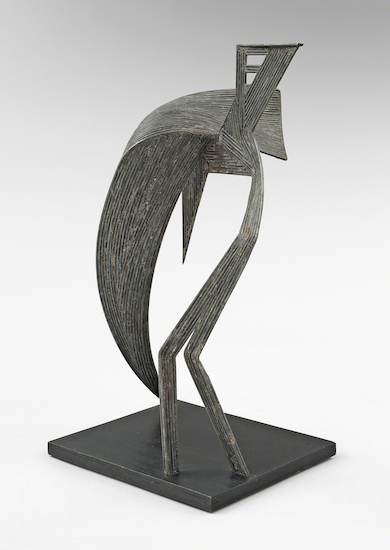 |
| Bernardus Antonius “Toon” Kelder, Mask, 1952-1953, iron wire, height: 59.6 cm without base The Museum of Modern Art, New York, © 2026 Artist or Estate of Artist (MOMA-S0119) |
Kelder began exploring sculpture after 1946. His sculptures were always abstract, but the starting point remained a motif from the physical world such as birds, masks, animals, and the female form. Mask comes from a series of similar works of the same title. There is definitely a sense of influence from Cubism. Kelder's sculpture was a search for the core, for the clear simplicity of form, plane and line. To find it, he abandoned figuration after World War II. Such wire sculptures as Mask seem almost drawn although his later works became more closed form.
Background
Progressive Dutch artist of the first half of the 1900s could not help but be influenced by the major trend called De Stijl. De Stijl was a severe reduction of forms -- in painting, sculpture, architecture and interior design -- to elementary geometric shapes and primary colors. A counterpoint to De Stijl during the same period before World War II (1939-1945) was the Bergen "school" that flourished between the wars 1915 to 1925.
Bergen school artists worked in figurative yet expressionistic subjects, often with touches of Cubism. Like most European countries at the time, the Netherlands also had a large community of modernist artists who avoided the doctrinaire approach of De Stijl (as dictated by Theo van Doesburg 1883-1931 and Piet Mondrian 1872-1944). These Dutch artists formed a whole different chapter of modernism removed from the dominance of De Stijl and its offspring Neo-Plasticism.
Toon Kelder was born in Rotterdam, Netherlands. He studied at the Academy there (now the Willem de Kooning Academy), and also at the School of Visual Arts in The Hague. After trips to France where he was impacted by the modernism of the School of Paris, he returned to The Hague where he remained the rest of his life.
With the urge to innovate beyond De Stijl, and follow his inner, rarified vision, his paintings from the 1920s until the mid-1940s reflect the influence of the Bergen School, mixed with the gestural brush work of Expressionism, and bright colors of Impressionism. His subject were objective, consisting of female figures, animals, and still life painted in soft, hazy tones that gave them a pseudo-abstract quality. A critic termed these paintings "dreamed reality."
Kelder was successful with patronage, but after the World War II (1939-1945) no longer cared about recognition by the public. Feeling that he was stuck in his own personal expression, he altered course to sculpture. His sculptures reflected the modernism he had seen in Paris, becoming completely abstract. What little painting he did after 1947 followed a similar vein, reduced to simple shapes in a limited palette, ultimately black on white paper. He worked on his art until his sudden death in 1973.

Comments