National Hot Dog Day: Art by Robert Abel (1937-2001 US)
Because of summer cookouts which often include hot dogs, the National Hot Dog and Sausage Council established National Hot Dog Day in 1991 to coincide with a hot dog lunch on Capitol Hill. The observance occurs every year on a Wednesday in July. Also, July is considered National Hot Dog Month. Ohioan Robert Abel was a pioneer in using computer-aided graphic design.
15 July is National Hot Dog Day: Art by Robert Abel (1937-2001 US)
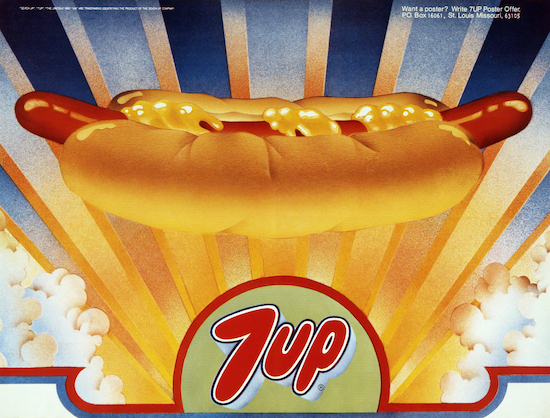 |
| Robert Abel, advertisement for 7UP, 1975, offset lithograph on paper, 115 x 151 cm The Museum of Modern Art, New York, © 2026 Artist or Estate of Artist (MOMA-D0568) |
Abel was born in Cleveland, and educated at UCLA starting in 1958. He received bachelor degrees in Theater (film division) and School of Design. He initially worked under John Whitney (1917-1993), who pioneered use of computer animation in short film and movie title sequences as early as 1961. In 1971 he formed a partnership (Abel & Associates), the focus of which was the creative use of computer-aided photographic effects for TV and movies.
Much of Abel's focus in the mid-1970s was TV commercials for 7-Up. Posters such as this were essentially offshoots of the visuals of those TV spots, which featured some of the first combinations of live motion overlaid on computer animation. This poster still has a Pop Art feel to it stylistically.
Background
The impact that the Arts and Crafts Movement had on American poster art (1890s-1910s) resulted in the extreme simplification of form, contrast of flat color shapes, and sparse backgrounds with minimal text. During the late 1920s, poster art in America was greatly influenced by the Art Deco style which proceeded from Paris after 1925. Art Deco presented the first infusion of modern design into American graphic design, as well as architecture and decorative arts. It was greatly influenced by the modernist movements of Germany, Russia and the Netherlands towards a streamlined, machine-inspired fine art aesthetic.
During World War II (1939-1945), graphic design necessarily returned to more or less an emphasis on realism. Poster art was dominated by public service messages concerning every aspect of the war effort from recycling at home to enlistment in every branch of military service for both men and women. What little influence of modernism was left appeared in the extreme simplification and flattening of form. Message was more important than avant-garde style.
America's victory in World War II created a massive world super power which was characterized by a self-confidence and energy that was reflected in all of the arts, including graphic design. America's massive industrial war effort had created the greatest economic engine in the world. There were new products and materials to excite the imagination of poster artists. The Art Deco style now seemed old-fashioned compared to the vibrant new world of merchandising that had presented itself.
Poster art of the 1950s, for the first time in America, took on styles that were represented in the most up-to-date avant-garde painting including European and (the revolutionary new) American non-objective abstraction. By the early 1950s, American posters were dominated by the Minimalist aesthetic and by imagery from American popular culture. Pop Art, evolving during the early 1960s influenced poster art until the late 1960s.
The flourishing rock and roll scene of the mid- to late 1960s engendered another renaissance in poster design. Grounded in the Beat movement, San Francisco became a subculture mecca starting in the mid-1960s as beatniks turned into hippies in an established counterculture. The counterculture established the psychedelic style of poster with extraordinarily imaginative new fonts for posters. The Pop Art aesthetic during the 1970s was augmented by advances in computer-generated art to form a new chapter in poster design. Many of the poster designs during the 1970s were visual continuations of the never-ending vitality and creativity of TV advertising. Robert Abel was a commercial director and producer of Robert Abel & Associates who was a central figure in computer-generated visual effects in advertising.
Correlation to Davis program: Communicating Through Graphic Design 2E, Chapter 7 Advertising Design -- A Little Advertising History

Comments