
August is for artist Augustus Vincent Tack (1870-1949 US)
I would use any excuse to show you the paintings of Augustus Vincent Tack, so I’ll go by his name. If you will pardon my pun, his paintings are very august. I have never been able to decide if I like his Impressionist phase (of course I do) better than his later mystical phase. Really, the more I look at this painting, the more I think of the Yamato-e landscapes in Japan, except that Tack did not use gold leaf. He created the illusion of it. If you want to see more glorious examples of this brilliant artist’s use of color, the Phillips Collection in Washington has tons of his works from all his periods.
August is for artist Augustus Vincent Tack (1870-1949 US)
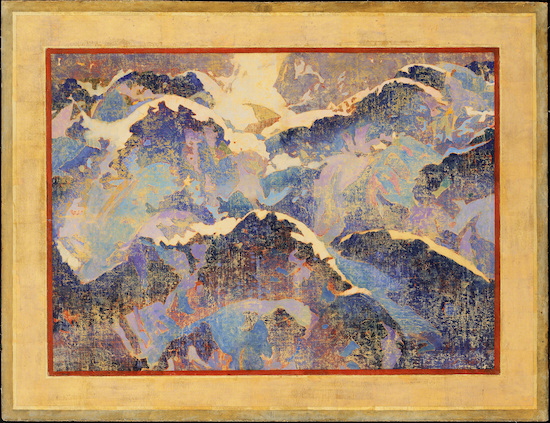 |
| Augustus Vincent Tack, Storm, ca. 1922-1923, oil on canvas on wallboard, 93.9 x 121.9 cm (37” x 48”) The Phillips Collection, Washington, DC, © 2026 Artist or Estate of Artist (PC-402) |
Tack's journey to abstraction began around the end of World War I (1914-1918). His first abstract landscape painting was exhibited in 1924. There are certain elements that appear in most of his abstractions that reflect his passionate enthusiasm for Japanese painting, and his experiences in the Rocky Mountains and Death Valley.
The omnipresent, wispy clouds/mist are a strong influence of the Japanese yamato-e landscape tradition where clouds are outlined and used to indicate depth. Instead of using gold, Tack devised a process using a photographic mounting roller coated with a mixture of white pigment and yellow ochre, which he dragged across the canvas. The flecks of golden ochre only adhered to the uneven textures of the paint, creating a shimmering optical illusion of "gold"
The frequent reference to canyons and mountains in these landscapes resemble more closely the American West rather than Japanese landscapes featuring imaginary mountains. There is an overall mysticism, and passion for color and decorative surface. The sectioning and outlining of elements of his compositions may reflect the additional influence of stained glass that he would have seen in the many church murals he painted. The title of this painting could easily be imagined as Storm in the Rockies.
Background
Throughout the history of American art, there have been artists whose vision is so personal that it can not be easily fit into a category. Examples of this in the 1800s would be David Gilmour Blythe (1815–1865), John Quidor (1801–1881), Ralph Albert Blakelock (1847–1919), and Albert Pinkham Ryder (1847–1917). While their vision was unusual, none of these artists ever truly strayed from the American naturalistic tradition.
In the 1900s, after the advent of and acceptance for abstraction in American art, many artists with intense, personal visions were free to explore these modes of expression, inspired by their travels, reading, or a combination of cross-cultural art historical influences. These personal visions span the range of total abstraction, to representational abstraction, regardless of what the current “trends” in American art are.
Augustus Vincent Tack was born in Pittsburgh. His family moved to New York when he was in his teens. While young he showed an inclination towards art. That was cemented when he attended a Catholic high school where the church’s mural decoration had a formative influence on him. He studied at the Art Students League in New York after high school, where he was mentored by John Henry Twachtman (1853-1902), an American Impressionist/Tonalist.
Tack went to Europe in 1890 (also 1893 and 1895) where he was mentored by American painter John LaFarge (1835-1910) who introduced Tack to Impressionists, including Claude Monet (1840-1926). While studying traditional drawing techniques, he also began painting in an Impressionist style. While notable for his highly suggestive, mystical Impressionistic landscapes, he also painted realist murals and portraits. Further influence on his Impressionist landscape style was Japanese art that he gleaned via LaFarge, and the landscapes of American Barbizon painter George Inness (1825-1894).
Tack taught at both Yale and Art Students League. His first studio in New York (1894) advertised him as a portrait painter, clearly to make ends meet. After 1897 he split his time between New York and a studio in Deerfield, MA, where there was an American Impressionist art colony.
Correlations to Davis programs: Explorations in Art 2E grade 1, lesson 4.4; Explorations in Art 2E grade 2, lessons 1.5, 1.6, 1.8, 1.9; Explorations in Art 2E grade 3, lessons 2.7., 2.8, 2.9, 4.9, 5.4; Explorations in Art 2E grade 4, lessons 3.1, 3.2, 4.4; Explorations in Art 2E grade 6, lesson 2.3; The Visual Experience 4E lesson 8.13; Experience Art lesson 4.1; Exploring Painting 3.E pp. 154-161; Exploring Visual Design 5E lesson 5.2

Comments