National Hamburger Day: Art by Claes Oldenburg (1929-2022 US, born Sweden)
National Hamburger day – origin unknown – has been celebrated since 2010 as a tribute to the beginning of summer. Who better to make fine art out of a hamburger than Pop artist Claes Oldenburg?!
28 May is National Hamburger Day: Art by Claes Oldenburg (1929-2022 US born Sweden)
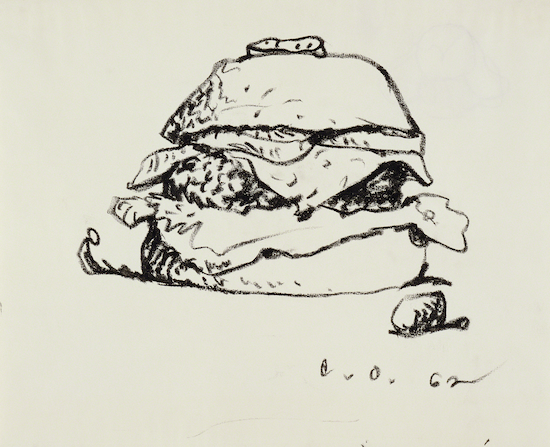 |
| Claes Oldenburg, Hamburger, 1962, lithograph crayon on paper, 35 x 43 cm The Museum of Modern Art, New York, © 2026 Estate of Claes Oldenburg (MOMA-S1124)
|
Oldenburg is famous for the copious number of studies he did for sculptures or public monuments. He has indicated that many of his ideas come while he is eating, possibly accounting for the large number of food-oriented sculptures in his body of work. This hamburger study dates from the period of the story. Executed simply in contour lines, its isolation on the sheet belies whether it is meant to be a "large burger," a bigger "floor burger", or a colossal public monument. Viewing the world-wide popularity of the American hamburger, it would be very appropriate as a colossal public monument.
Background
Surrealism and Dada of the first half of the 1900s influenced Pop Art, which developed in the 1950s as a reaction to the dominance of Abstract Expressionism in American art. Like the two earlier movements, much of Pop Art relied on everyday found objects, the insistence of chance as an element of creation, and the redefinition of what was valid subject matter. Pop artists turned to objects and events of the everyday world in the United States, the most materialistic and commercially society in the world.
Claes Oldenburg was born in Stockholm, but his father, a Swedish diplomat, moved the family to the United States when he was a child. Moving first to New York, then Chicago, Oldenburg attended Yale University, and then studied art at the School of the Art Institute of Chicago. While attending the Art Institute, he had his first public show of some of his satirical drawings.
After graduating, Oldenburg moved to New York. He immediately became involved in the germinal Pop Art movement, befriending performance artist Allan Kaprow (1927-2006). He also associated with Pop Art painter Jim Dine (born 1930). Oldenburg’s first show in New York in the mid-1950s was a collection of found objects, and sculptures made of found pieces of wood, paper and string.
Oldenburg had major impact on the Pop Art movement in 1961 when he opened The Store on the Lower East Side of New York. The Store was an actual shop where the sculptures inside were for sale. The sculptures consisted of often crudely painted plaster depictions of everyday objects seen in store windows. Some of these objects became the model for his later larger-scale pieces. Many of the objects in The Store were knock-offs of common food items.

Comments