
This Day in History 11 August, 1180: Passing of William of Sens (France)
If you are a big fan of Gothic European architecture, then you will realize that today marks the day in 1180 when the French architect died who introduced the first of the French Gothic style into a British cathedral structure.
This Day in History 11 August, 1180: Passing of William of Sens (France)
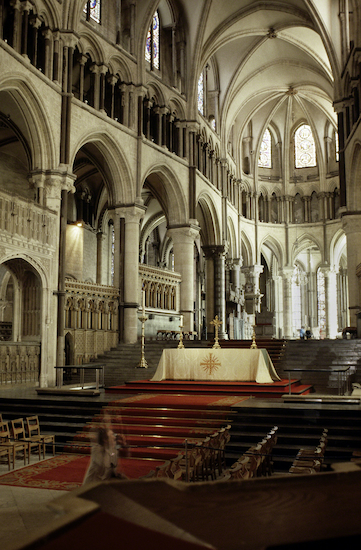 |
| William the Englishman (died ca. 1214) and William of Sens, Canterbury Cathedral, begun 1070, Choir rebuilt starting in 1174 Image © 2026 Davis Art Images (8s-23584)
|
After a fire destroyed the east end of Canterbury Cathedral in 1174, the choir was rebuilt in a more modern design of a French architect. The new design reflected the influence of the concurrent French Gothic style, including pointed arches, flying buttresses (possibly copied from Notre-Dame in Paris), six-part ribbed vaulting and greater height. It was the first completely Gothic architecture in England. The Choir made some concessions to English Romanesque tastes.
The interior, although higher than most English cathedrals, did not reach the dizzying height of French Gothic cathedrals, and the clerestory passage was retained, a typical feature in English cathedral buildings. The design shows decorative features that English builders delighted in such as multiple moldings on arches and on piers, and also the clustering of numerous colonnettes.
Background
The stylistic transition of architecture from Romanesque to Gothic coincided with the evolution of a strong monarchy in France during the 1100s. France had become a political and cultural power that far outstripped the Holy Roman Empire in importance. This coincided with the rise in importance of secular power in Britain, Spain and the Italian city-states. This indicated the beginning of the decline in domination by the Roman Church, however, secular rulers still relied on the commission of large works of religious art and architecture as ways of maintaining their power.
Gothic architecture blossomed due in large part by the huge sums of money spent by French rulers on developing even larger and grander church architecture than the previous period. This meant bigger and more decorated. The quest for higher structures led to engineering breakthroughs in the use of ribbed vaults to support stone ceilings, external buttresses to support thinner walls with more windows, and the use of the pointed arch that supported more weight and could span bigger spaces than the round arch.
The "beginning"of the Gothic style is pinpointed to the rebuilding of the church of the Abbey of Saint-Denis near Paris from ca. 1135-1144, in which these principles were used for the first time.
The new Gothic architecture did not have an immediate impact past northern France. Frequently, some Gothic features were incorporated into what was still a Romanesque structure. In Britain, Romanesque building went on throughout the 1100s. Some Gothic elements were brought in from France by Cistercian architects. The first wholly Gothic structure was the choir of Canterbury cathedral rebuilt after a fire in 1174. Significant differences between British and French Gothic are the asymmetrical floor plans, ambulatories in the nave gallery, the lack of towers on the west facade, less emphasis on height of the nave, and horizontal, screen-like facades that extend beyond the lateral walls of the nave.
Canterbury Cathedral is located on a site that was sacred to Celtic peoples long before the Romans occupied in 43 CE. The earliest church dated to Roman times, but a cathedral was not established until 597 CE, when it became the primary bishopric for the English Christian church. Saxon buildings dating mostly to the 700s through 900s were replaced by a Romanesque structure that was dedicated as a cathedral between 1070 and 1077, and it was modified in the 1100s.

Comments