National Great Outdoors Month: Art by Cheng Tsung Feng (born 1987 Taiwan)
National Great Outdoors Month began as National Great Outdoors Week in 1998 in the US. In 2019 the US Senate created National Great Outdoors Month for June, to encourage people to enjoy the recreations available in our beautiful country. I am introducing you to a radical new type of “landscape” – the great outdoors formed by bound books. It’s brilliant!
June is National Great Outdoors Month: Art by Cheng Tsung Feng (born 1987 Taiwan)
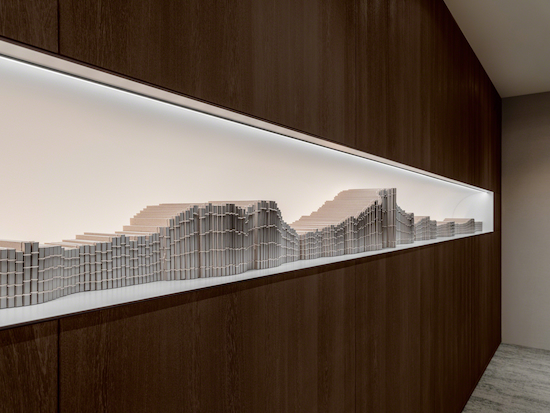 |
| Cheng Tsung Feng, Collection of Mountains: Mount Jade, 2023, handmade bamboo cover books, various sizes Raffles Family Office, Taipei, Taiwan, Image © 2026 Cheng Tsung Feng (8s-30661) |
For this installation artwork at the Raffles Family Taipei office, he used a kind of book binding method with a long history which is called “Chinese Stitched Binding” (xian zhuang) to make a large number of handmade books in various sizes. He collected these books on a huge bookcase to form the shape of the highest mountain in Taiwan – Jade Mountain. The interplay of light and shadow within the bookshelf mirrors the day and night cycles in Taiwan. In the true spirit of traditional Chinese landscape painting, Cheng gives this work a contemplative spin: "As people gaze upon this Jade Mountain, they see the silhouette formed by impressions of the sky. They think of here and there, anticipating either a return or an imminent departure."
Background
In the art of East and Southeast Asia, bamboo has significant symbolism, representing virtues such as integrity, modesty, and resilience. Bamboo woven objects can be traced as far back in China as the 5000s BCE, with the earliest example discovered in Yuyao in Zhejiang Province. From the Shang (ca. 1523-1028 BCE) to the Han Dynasties (206 BCE-220 CE) bamboo weaving was used primarily for household utensils and farming tools. From the Sui (581-618 CE) to Tang (618-907 CE) Dynasties bamboo weaving became more sophisticated with decorative applications.
By the time of the Qing Dynasty (1644-1912) bamboo weaving technology was combined with other media such as lacquer. There are over 1200 species and varieties of bamboo. Geographically bamboo occurs throughout China, from the southern tip of Hainan Island to Beijing, and from Langxiaan in Tibet to eastern Taiwan.
Cheng Tsung Feng was born in 1987 in Taiwan. He graduated in industrial design from Yunlin University of Science and Technology, having learned nothing about traditional “handicraft” art forms. He initially designed in trends that were popular in Europe, America, and Japan. In 2013 he participated in a project of the National Taiwan Craft Research and Development Institute which paired designers with traditional “craftspeople”, whose collaborative projects were then exhibited at Milan Design Week.
For Cheng, this was the spark that lighted his passion for working with bamboo. With bamboo artist Chen Gaoming he designed the Flow bamboo chair which helped transform the contemporary public’s perception of bamboo as an art form. After that Cheng visited many veteran craftspeople all over Taiwan to learn bamboo art, among many other “craft” forms. In 2015 he established Studio Kao Gong Ji which designs tableware, light fixtures and furniture. Kao GongJi translated means Book of Diverse Crafts, a text considered the oldest known technical encyclopedia, written between the 400s and 200s BCE.
Correlation to Davis program: AP Art History, Content Area 10 -- Global Contemporary

Comments