International Tiger Day
This beautiful piece of Cizhou ware dates from a period when tigers were not an endangered species. In 2010, the Saint Petersburg Tiger Summit of 13 tiger-range countries in Russia established International Tiger Day to address the awful fact that 97 per cent of wild tigers have disappeared over the last 100 years. The establishment of this day spurred anti-poaching efforts, protected animal habitats, and educated the public.
29 July is International Tiger Day: Art by Chinese Artist
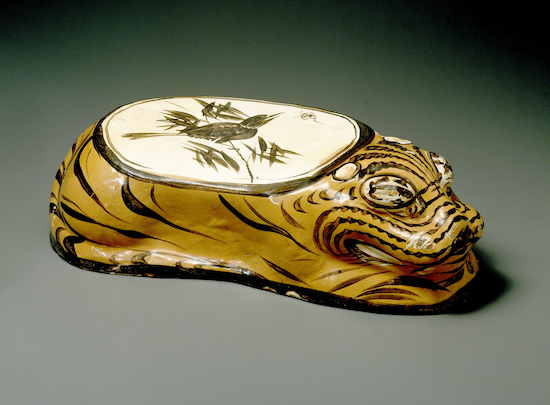 |
| China, Southern Song Dynasty, Tiger-form pillow, 1182, Cizhou ware earthenware, 11.1 x 17.1 x 36.8 cm © 2026 Brooklyn Museum (BMA-5374)
|
Ceramic pillows began to be used in China during the Sui Dynasty (581-618 CE). Mass production of ceramic pillows began during the Tang Dynasty (618-907 CE) and lasted in importance through the Yuan Dynasty (1280-1368). It was believed that ceramic pillows helped students to study harder because they awoke frequently.
Ceramic pillows were also cooler in hot summer months. Ceramic pillows also had auspicious meaning, painted with auspicious animals and sayings. Aside from its strength, the tiger in China was a symbol of the cardinal direction east, as well as darkness, and the yin of "yin and yang" (dualism). In Buddhism the tiger is symbolic of solitary enlightenment. They were also auspicious in Daoism, thought to be able to exorcise evil.
Cizhou was primarily a northern ware, produced north of the Yellow River. The main production center of Cizhou was kilns in Cixian and Pengcheng in Hebei province which flourished during the Jin-Song dynasty. The ware was produced for daily use, mostly household vessels and utensils, and pillows.
Background
The Song Dynasty (960-1279) is considered one of the most significant periods of cultural and artistic development in Chinese history. It was a period of tremendous pressure by various cultures outside of China in the north, with the constant threat of invasion.
Northern China fell to invaders who established the Jin Song Dynasty (1115-1234), and after 1127 the Song ruled only south of the Yangtze River. The Song Dynasty collapsed when the Mongols invaded China, first taking the northern (Jin) dynasty (1211) and ultimately defeating the Southern Song fleet in 1279. Despite the turmoil of the period, the Song dynasty is considered the finest period of artistic development, particularly in painting and ceramics.
Correlation to Davis program -- Exploring Visual Design 5E, lesson 6.4 Looking at Art, Texture

Comments