National Bring Someone Flowers Day: Art by Joseph Blackburn (ca. 1730-ca. 1778 US)
Although the origins of this national day are obscure, National Bring Someone Flowers Day has been celebrated on 15 May to encourage the spur-of-the-moment gesture of giving flowers to someone dear. Bouquets of flowers have been shared between human beings from the very earliest organized human societies, and over the centuries floriography – the symbolism of certain flowers – has become common.
15 May is National Bring Someone Flowers Day: Art by Joseph Blackburn (ca. 1730-ca. 1778 US, probably born Britain)
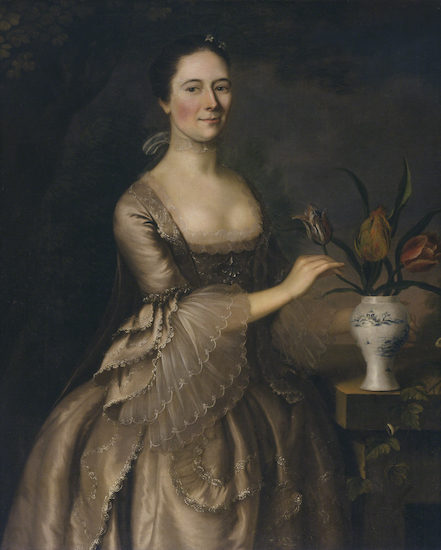 |
| Joseph Blackburn, Portrait of a Woman, ca. 1762, oil on canvas, 111.8 x 91 cm © 2026 Brooklyn Museum (BMA-610)
|
Blackburn's style brought with it the emphasis on luxurious materials, pastel colors, detailed renditions of fruit and flowers, and a gracious, reserved realism of his sitters. While the features are expertly handled and the body reveals a sculptural form, Blackburn, like Wollaston, was not in the business of giving his sitters an obvious personality. This upper-class woman's gentility and breeding are emphasized in her delicately arranging flowers. Her status is further emphasized by the Chinese import porcelain vase, a costly item for wealthy colonials imported through Britain. The tulips she arranges – a flower that symbolizes true love or the rebirth of spring – could indicate that this was a wedding portrait for this young woman.
Like the British painters of country gentry, Blackburn often portrayed his subjects in a garden setting with a bucolic background. Interestingly, this portrait avoids the artist's tendency to pose people frontally, with their head turned slightly to the right. Blackburn introduced to American colonial portraiture the "conversation portrait", group portraits in which the subjects are engaged in conversation.
Background
As prosperity increased during the 1700s, the more affluent American colonists wanted to reflect the cultivated taste in painting of their counterparts in Britain. Many1700s painters looked to British painters of the day for stylistic influence.
Most colonial painters were self-taught due to the total absence of art academies. The early colonial style, based largely on prints of English portraits tended to be flat, evenly lit, and rich in realistic detail. Early portraits are characterized by unsophisticated draftsmanship, awkward rendering of anatomy, and emphasis on the luxury items of the sitter.
By 1750, the American style began to change with the first influx of European artists, mainly from Britain. These academically trained artists were aware of the more current stylistic trends and techniques in painting. They also brought with them a group of stock poses and attitudes in portraiture. Another factor was the rise in the number of American-born artists.
The late Baroque style was enthusiastically embraced by the more sophisticated colonial patrons. The American colonial style reached its height between 1750 and 1775, a combination of London-trained painters or American artists who had studied in Britain, with the American fondness for unswerving realism.
Like painter John Wollaston (ca. 1710-1775), Joseph Blackburn came from Britain equipped with the Rococo aesthetic. Little is known about his origin or training, although he may have been a painter of drapery in another artist's studio before he decided to try his luck in the colonies. He is known to have spent two years painting portraits in Bermuda ca. 17521-1753, before he emigrated to Newport, RI, in 1754. He moved to Boston in 1755 where he set up a studio. During his brief stay in the colonies, he painted about 150 portraits. He returned to Britain in 1764, where his painting career has become obscure.

Comments