
Artist Birthday: Watanabe Kunio (born 1967 Japan)
Long before ceramic arts were recognized as fine art in the West, the art form was revered as a priceless national treasure in Japan. Contemporary artists like Kunio Watanabe continue to build on the centuries old ceramic traditions of Japan.
Artist Birthday for 3 June: Watanabe Kunio (born 1967 Japan)
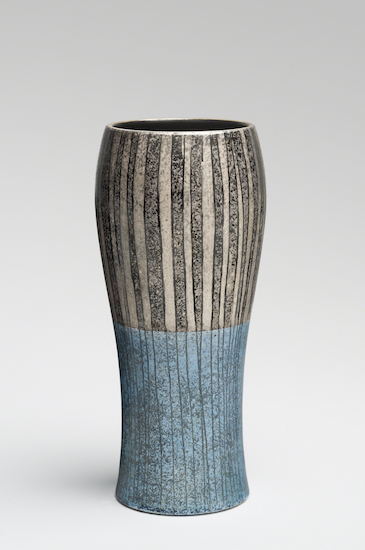 |
| Watanabe Kunio, Tea whisk container, 2012, porcelain, height 10.2 cm Philadelphia Museum of Art, © 2026 Watanabe Kunio (PMA-7887) |
Kunio Watanabe (1967) graduated from the Tokyo University of The Arts where he studied under Celadon Living National Treasure Miura Koheiji (1933-2006). Watanabe’s chosen style is not celadon though, yet overglaze enamel designs that are multi-colored and prismatic.
Watanabe bisque fires first then over numerous times paints on the various colors, firing again, overlapping and repeating. In 2008 he showed at the Philadelphia Museum of Art in an exhibition titled "Five by Eight – New Ceramic Art from Japan" and a work was added to the museum’s collection. The same year he was awarded the Traditional Japanese Arts and Crafts Award.
Watanabe is renowned for his tea ceremony wares. The whisk is of vital importance to the formal tea ceremony. The tea is whisked in the bowl after hot water is added to the powdered matcha tea, creating a green foam that indicates the tea is ready to hand to the guest. When a whisk (chasen) is cleaned with hot water, it is place with the bamboo whisk wire spread out over the striped portion of this vessel, a chasen-tate. Watanabe has cleverly decorated this whisk holder with a stripe pattern, each of the contour lines defining one wire of the bamboo spread over it.
Background
The Japanese tradition of ceramics is one of the oldest on Earth. The Jomon culture, that flourished between 5000-200 BCE, created the first ceramics on the planet that were decorated for decoration's sake rather than ritual purposes. Porcelain developed in Japan during the 1600s, pioneered mostly by Korean ceramic artists who had come to Japan in 1590. The tea ceremony (chanoyu) and flower arranging (ikebana), influenced by Zen Buddhism, are cultural developments of the 1500s that brought increased respect for the ceramic arts.
In the early 1900s, inspired by the British Arts and Crafts Movement, reacting against the rapid "westernization" and industrialization of Japan, a group of ceramic artists founded the Japanese Folk Art Association. This group of artists promoted the idea of the hands-on ceramic artist, one who took part in every stage of making ceramic vessels.
The need to restore national identity after the disaster of World War II (1939-1945) helped strengthen the movement to fortify traditional art forms. The reverence and respect for ceramic arts in Japan elevated the art form to the same status as painting or sculpture.
Unlike their counterparts in China and Korea, contemporary individual Japanese ceramic artists have traditionally enjoyed almost star-like status. This idea has been perpetuated by the government sponsored exhibitions of ceramic art and public recognition of artists who are designated Living National Treasure.
Correlation to Davis program: Experience Clay 3E, Chapter 6 Thrown Forms -- Throwing the Cylinder

Comments