Artist Birthday: Domenico Ghirlandaio (1448/1449-1494 Italy)
The Renaissance in 1400s Italy was a restatement of the styles of ancient Greece and Rome, a symptom of a more humanistic view of Christian religious figures in Renaissance painting. Many of the leading painters of this period, like Ghirlandaio, were active in the city of Florence.
Artist Birthday for 2 June: Domenico Ghirlandaio (1448/1449-1494 Italy)
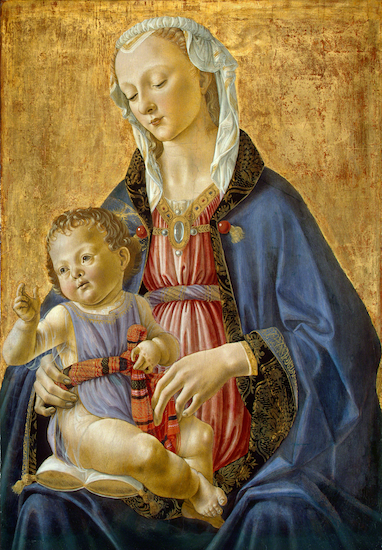 |
| Domenico Ghirlandaio, Madonna and Child, ca. 1470, tempera on panel with gold leaf, transferred to hard board, 70.8 x 48.9 cm © 2026 National Gallery of Art, Washington (NGA-P0126) |
This work by the young Ghirlandaio contains an old timey element in the earlier Renaissance -- the gold leaf background -- but the balanced pyramidal composition, plasticity of the figures, and humanizing of the subject is pure developed Renaissance. Ghirlandaio's Mary resembles those of another early Renaissance painter Fra Filippo Lippi (1406-1469) who normalized the depiction of Mary as a beautiful, normal young woman of 1400s Florence. This aesthetic for the figure of Mary endured in the work of the Renaissance painter Sandro Botticelli (1445-1510) and also in Baldovinetti’s own version of the “sweet Madonna”.
The blue cloak Mary wears is the standard symbol for the sky, which indicates her status as "Queen of Heaven", a reference that dates as far back as the 300s CE in the early Church. Her high forehead is a symbol of her wisdom (in accepting God's offer to bear Jesus). The Christ child, sitting on a cushion that indicates his divine status as the perceived son of God, while he raises his hand in blessing, an indication of the many miracles that he would perform during his ministry on Earth.
Background
Italian artists in the late 1200s were clearly influenced by the Byzantine efforts at spatial perspective, and also showed an interest in convincing spatial relationships between figures and settings, logical depiction of light and shade, and more plasticity to figures.
When the papacy moved to Avignon in 1309 (until 1417), Rome declined as an artistic center, but the ideas developed there persisted in the Tuscan cities of Siena, Florence, Pisa and Lucca. By the 1200s, Florence had developed into a flourishing banking center, with trading relationships throughout Europe. The people of the Florentine city-state viewed themselves as the equal of the culture of ancient Greece and Rome. The wealthy families of Florence showered the arts with patronage, and were also patrons of scholarship and literature. The interest in studying classical antique literature and applying it to everyday Florentine life is reflected in the development of a humanistic, realistic art that celebrated the achievements of humans, while glorifying the divine through beautiful painting, sculpture and architecture.
While surviving art works from classical antiquity had an impact on Italian artists before the 1400s, its impact was even greater during the 1400s. The impact of antiquity first manifested itself in sculpture and architecture, since few if any examples of ancient painting were available. Some painters were influenced by the new sculpture, while many in the first two decades of the 1400s still painted in Gothic-derived styles.
Brunelleschi's "discovery" of one point perspective while doing studies of monuments in Rome was codified in Ghiberti's book Della Pittura (About Painting, published in Florence) of 1436. This combined with painters who emerged in Florence working in styles that combined the influence of antique sculpture with direct observation of nature in the 1420s. The artists and philosophers at the time knew that they were producing a new art in a thrilling ground-breaking period. The result was what is now called the Renaissance.
Domenico Bigordi is called Ghirlandaio ("garland-maker") after his well-known jeweler father in Florence. He first apprenticed under Alesso Baldovinetti (1427-1499) and may have under Andrea del Verrocchio (1435-1488). Many of his earliest works were frescoes in churches. During his lifetime, some critics considered Ghirlandaio's colors too bright, although his firm grasp on one-point perspective and contrasts in dark and light to build form (chiaroscuro) earned him many commissions.

Comments