National Beverage Day
National Beverage Day began around 1921 or 1922, originally known as National Carbonated Beverage Day. The day encourages people to grab their favorite drink and relax with friends. But, beverages are also sometimes related to certain faith practices, such as this Chinese, Shang Dynasty bronze.
6 May is National Beverage Day
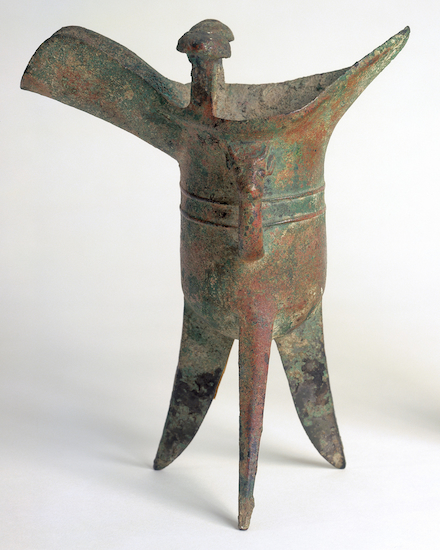 |
| China, Shang Dynasty (flourished ca. 1523-1028 BCE) Jue, 1200s-1000s BCE, bronze, 19.7 x 15.9 cm Image © 2026 Buffalo AKG Art Museum, Buffalo, NY (AK-267)
|
The jue was a ritual wine vessel. The jue was meant to store, heat and serve wine during ancestor worship ceremonies. Every ancient Chinese bronze thus far discovered was cast using a complex pottery section-mold—a Chinese invention. But this vessel’s shape—angular, with a thin-walled body, a rim that appears “folded over,” and a “strap” handle—implies an earlier hammered sheet-metal mode of manufacture that might have been introduced from western Asia, where bronze metallurgy developed two thousand years before it appeared in China. This vessel is surprisingly simple in its banded decoration and the lack of the tao-tieh pattern.
Background
Pottery shards and skeletal remains found in Beijing indicate that there was human life in China as far back as 500,000 years ago. Persistent culture seems to have developed in the same area some 20,000 years ago. Sophisticated art was already being produced in China the Stone Age (2000s BCE) and was centered in cultures mostly in the upper Yellow River area.
Over the centuries, cultural development followed a pattern that would last throughout China’s long history -- the development of high culture, then invasion by barbarians, followed by decay and decline, and then another period of high culture.
China evolved from a nomadic to settled culture around 1600 CE. The first recorded dynasty was the Shang (c.1700-1028 BCE). It left evidence of royal houses, carvings in stone, urban centers, bronzes and script. The Bronze Age in China (ca. 2000-200 BCE) produced a large variety of vessels all with intricate incised and raised decoration.
The earliest Chinese bronzes were excavated near the modern city of Louyang, Henan province. It may have been an early Shang capital, however, the capital that endured through the reigns most Shang emperors was Yin, near the present-day city of Anyang.
It was in the vicinity of Anyang that 14 royal tombs were uncovered revealing the fabulous wealth of Shang rulers in the numbers (hundreds) of bronze vessels buried with them. The right to own or cast bronze is thought to have been restricted to the ruling class. Bronze vessels were used in symbolic and shamanistic rituals to honor deceased clan ancestors. They were probably stored in shrine-like halls. During the mid- to late Shang period, bronze vessels were symbols of status, power and prestige.

Comments