Artist Birthday: Tsujimura Shirō (born 1947 Japan)
Like many of the Japanese artists born after World War II (1939-1945), the art of Shirō Tsujimura is a reverent combination of honoring ages-old Japanese artistic traditions, and adding contemporary aesthetics – such as abstraction – to their work.
Artist Birthday for 22 May: Tsujimura Shirō (born 1947 Japan)
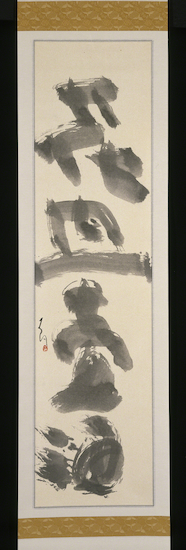 |
| Tsujimura Shirō, Drinking Alone After Midnight, 2003, ink on paper mounted as hanging scroll, 135.9 x 34.6 cm Brooklyn Museum, © 2026 Shirō Tsujimura (BMA-5402) |
Tsujimura's bold, idiosyncratic ceramic pieces are matched only by his bold calligraphy style. His work is influenced by a calligraphy style called bokuseki, meaning "ink trace". This style was developed by Zen Buddhist monks. It is characterized by invention, personal expression, and often, a studied disregard for calligraphic rules. Such works as Drinking Alone by Moonlight are hard to read, because the calligrapher prizes the vitality and dynamic fluidity of brushwork -- achieved by never letting the brush leave the paper -- rather than legibility.
Drinking Alone by Moonlight is the title of a poem by famous Tang dynasty Chinese poet Li Bai (701-762 CE). Tsujimura was inspired to produce several hanging scrolls containing this title after seeing the title inscribed in wood on a building at the Hōryū-ji temple complex near Nara. Li Bai suggests in the poem that the moon and his shadow can be companions if none of his scholar friends stop by on an evening of having drinks and appreciating the moon.
Background
Shirō Tsujimura is one of the most influential ceramic artists in Japan today. Born in Gosei, near Nara, he began his artistic journey studying oil painting. Disillusioned with that process, he abandoned it. In 1965, on a visit to the Japan Folkcraft Museum in Tokyo, Tsujimura became impassioned about ceramics after seeing a classic ido tea bowl on display. Ido is a traditional form of tea bowl, an inverted cone on a base. Ido means "deep well". Thereupon he decided to take up ceramics.
After returning to his father's farm in 1968, after spending two years at the Zen Sansho-ji temple in Nara, Tsujimura built a potter's wheel from the wheel of an old cart, and practiced throwing at night. In 1970 he bought a house in Mima, near Nara, also building a tea pavilion, a workshop, and ultimately, seven kilns. A completely self-taught ceramic artist, he had his first public exhibition in Osaka in 1978. Creating an enormous range of forms and glazes, Tsujimura is greatly influenced by Momyama era (1573-1615) tea aesthetics in his ceramics.

Comments