
Artist Birthday: Ashley Bickerton (1959-2022 US)
Ashley Bickerton’s work was symbolic of the late 1900s current in Neo-Geo movement in which surface and composition were secondary to the emphasis on documenting past attempts to order society with overt consumerism and industrialization.
Artist Birthday for 26 May: Ashley Bickerton (1959-2022 US, born Barbados)
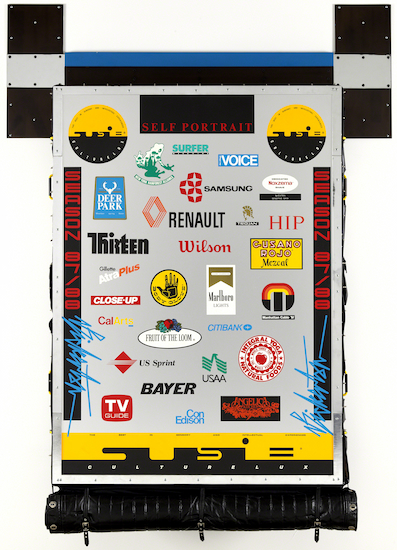 |
| Ashley Bickerton, Tormented Self-Portrait (Susie at Arles), 1987-1988, synthetic polymer paint, bronze powder and lacquer on wood, anodized aluminum, rub, plastic, formica, leather, chrome-plated steel and canvas, 227.1 x 174.5 x 40 cm The Museum of Modern Art, New York, © 2026 Artist or Estate of Artist (MOMA-S0519)
|
In Tormented Self-Portrait (Susie at Arles), Ashley Bickerton’s attempts to redefine the genre of self-portraiture to reflect contemporary consumer culture. The piece expresses the artist’s disillusionment with not finding the paradise he expected when he moved to Indonesia to escape the consumerism of Western society The assortment of corporate logos appears above a logo-like name — his signature for the Susie series — suggesting that the artist cannot escape a commercially oriented art world, even when he’s living in a so-called paradise. This series of Tormented works was produced during the 1980s, the height of the “star artist” boom in America, when artists’ works were reduced to commodities, much like the logos that appear in this artwork. Arles ironically refers to Vincent van Gogh (1853–1890) who produced numerous self-portraits in that French town, many of which were used in 1900s advertising and logos.
Background
Born in Barbados, Ashley Bickerton was a well-known figure of the 1980s Neo-Geo movement in New York. The artists of that movement were interested in appropriation but wanted to add elements of personal expression in the recontextualization of appropriated objects or imagery. By 1997, Bickerton was fed up with the artifice and self-aggrandizement of the New York art scene and moved to Bali.
Like Paul Gauguin (1848–1903), Bickerton expected to find a paradise of non-Westernized culture that was not stagnant with technology and consumerism. He was initially disappointed in the developed civilization he found in Bali, and late in life he expressed his frustration in canvases and objects of brilliant color and gesture.
Correlation to Davis program: Experience Art, lesson 3.

Comments