Artist Birthday: Albrecht Dürer (1471-1528 Germany)
Like the great Italian Renaissance artist Leonardo da Vinci (1452-1519), Albrecht Dürer was a singularly “Renaissance Man.” He was not only an accomplished printmaker and painter who reflected the humanist and classical ideals of the Renaissance, but his interests also extended to science, nature, and mathematics.
Artist Birthday for 21 May: Albrecht Dürer (1471-1528 Germany)
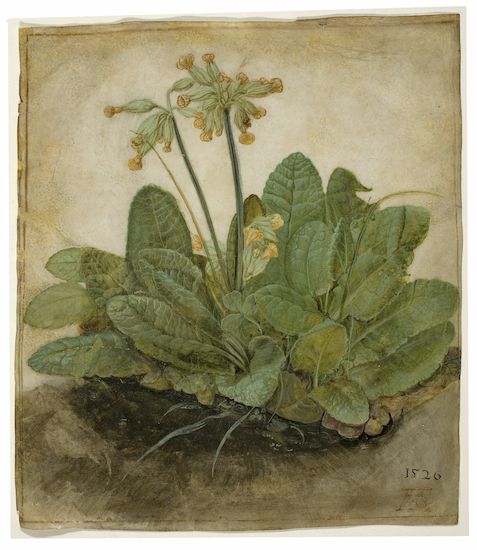 |
| Albrecht Dürer, Tuft of Cowslips, gouache on vellum, 19 x 17 cm © 2026 National Gallery of Art, Washington (NGA-P1245)
|
Dürer's brand of German extreme realism was reinforced by an acute interest in the science of nature. This detailed depiction of a common yellow weed has been elevated to the status of fine art in Durer's treatment. His use of opaque watercolor was a way to easily imitate the effects of oil painting while making studies. Opaque watercolors on vellum (calf hide) were often the medium and support of illuminated manuscripts from earlier periods. Dürer's botanical studies became models for a genre of scientific art that flourished in the 1500s, particularly in northern Europe, called florilegium (Latin for collection (literally “gathering”) of flowers).
During the Middle Ages (1000-1400), hundreds of botanical specimens were introduced to Europe from the Mediterranean and Middle East because of the Crusades. Like his landscapes and portraits, Dürer devoted as much attention to the precise realism of detail of nature. He did dozens of studies of various elements of nature, including flowers, wildflowers and animals, all with the same scientific interest in accuracy as is seen in the paintings of Leonardo. Dürer painted these samples in the field, rather than as isolated specimens, however, they became models for botanical studies that evolved into a thriving printmaking genre during the late 1500s.
Background
Just as the rising prosperity of the merchant class had created a new class of patrons of art during the 1400s in Flanders, thus spawning the Renaissance in northern Europe, the same was true in the Germanic States. Present day Germany and Switzerland were part of a loose confederation of states called the Holy Roman Empire.
Established with the coronation of Charlemagne by the pope in Rome in 800, the Holy Roman Empire lasted, more or less uninterrupted until the 1700s, with an emperor ruling from Germany. Artists guilds flourished beginning in the 1300s and trade flourished under the auspices of the Hanseatic League, a group of cities and trading outposts that stimulated trade and enriched a growing merchant class.
During the 1400s, Germanic Renaissance art was of two stylistic types -- one was a continuation of the International Style, which emphasized rich surfaces, pattern, elongated figures, softness of contours and sweetness of expression. The second type was artists who emphasized an intense investigation and detail expression of the physical world. The interest in physical realism eventually dominated, spurred on by the intense realism, atmospheric space and secular emphasis of Flemish art.
Like many of the masters of the Italian Renaissance such as Leonardo and Michelangelo, Albrecht Dürer was an artist whose interest transcended painting and drawing to science, engineering, and design. Born in Nuremberg, he began his artistic training as a draftsperson in his father's goldsmith shop, designing products and decorative motifs that would be incised into the objects. Printmaking is thought to have evolved from pattern books for armorers who inked and printed their designs for incised decoration on parade armor.
Dürer subsequently trained for three years in the shop of painter and printmaker Michael Wohlgemuth (1434-1519) beginning in 1486. After his apprenticeship ended in 1490, he visited other printmakers in the Netherlands and Germany, including the Housebook Master (1450-1500) in the middle Rhine. His painting style was greatly formed during his first trip to Italy in 1494.
While in Italy Dürer immersed himself in classical art and the new humanism of the Italian Renaissance. He is also thought at this time to have studied artists who based figure construction on geometry. This may have led him to later publish his own theories about the mathematical relationship to painting.
Correlations to Davis programs: Discovering Art History 4E, lesson 2.1; Experience Painting, Chapter 2

Comments