Late Summer Color: Theodore Robinson (1852-1896 US)
This is certainly one of the most French-Impression-like Theodore Robinson paintings that I can show you. He certainly mastered Monet’s “broken color” technique. No wonder he’s one of my favorite American Impressionists!
Late Summer Color with Theodore Robinson (1852-1896 US)
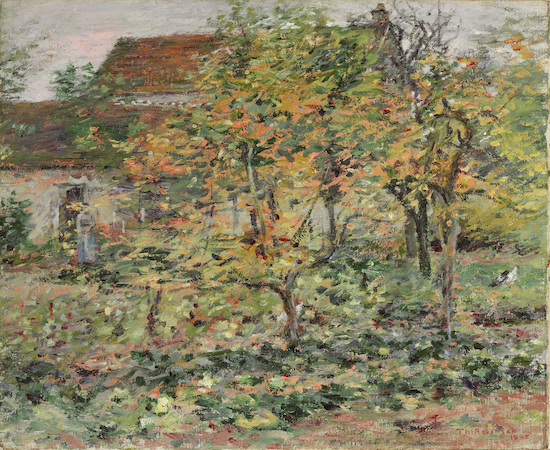 |
| Theodore Robinson, Yellow Apples, 1892, oil on canvas 45.7 x 55.9 cm (18” x 22”) Image © 2026 Philadelphia Museum of Art (PMA-8510) |
This view of a farm in the environs of Monet’s home in Giverny displays the typical high-key, though more muted, Impressionist palette, the dissolution of form in color, lack of contours, and reliance of a visual interpretation of subject matter. It is probably one of Robinson's most radical works in terms of dissolution of form. Color is the only indicator where one form begins and another ends.
Robinson embraced Monet's practice of painting the same view at several different times of the day and year, thereby altering the palette in each. His use of pale cobalt violet as highlights on the roofs reflects a practice in Monet's landscapes. His work, however is distinguished from Monet by a thinner application of paint. After returning to the US in 1892, Robinson pursued landscape painting outdoors the rest of his all too short life.
Background
American painting of the 1800s was dominated, starting in the 1820s, by a romantic naturalism that was inherently British in origin. The Hudson River School and its adherents are examples of the romantic realism. After the horrors of the Civil War (1860-1865), romantic naturalism no longer seemed a relevant trend in American art, though it persisted to some extent.
Many American artists born in the 1840s and 1850s looked elsewhere for inspiration than to Britain. Exciting American emigré enclaves of painters popped up in Munich and in Paris. They brought back with them alternatives to the academic manner ranging from Tonalism and Dark Impressionism, a revived academic classicism, mysticism and symbolism, and most of all, Impressionism. Although late in coming to America, the style quickly caught on in the final two decades of the 1800s.
Theodore Robinson was one of the first to explore Impressionism. Born in Irasberg, Vermont, his family moved to Wisconsin at an early age. Encouraged by his mother, he studied at the Chicago Academy of Design in 1869. He subsequently studied at the National Academy of Design in 1874, but rejected its archaic, conservative curriculum, and became one of the founding members of the more liberal and open-minded Art Students League (1875).
Moving to Paris in 1877 like many young artists at the time, he studied initially under academic painters such as academic classicist Jean Léon-Gérôme (1824-1904) and academic realist Emil Carolus-Duran (1837-1917). In 1877 he began to spend summers in Grez-sur-Loing where a small group of American artists drawn to open air landscape painting of French Barbizon style, notably J. Carroll Beckwith (1852-1917) and John Singer Sargent (1856-1925). In 1879, he returned to the US to teach art and assisted the mystical realist John la Farge (1835-1910) in mural projects.
By 1884 he had returned to France, spending summers in Barbizon, the founding place of Realism and Impressionism. 1887 was the first of five summers Robinson spent painting in Giverny, near where Claude Monet (1840-1926), the leading Impressionist, had moved in 1883. Ultimately, Robinson became one of the few Americans to develop a close relationship with Monet, which formed the epiphany moment in his painting style. Robinson adapted an Impressionist palette, though it was more muted than his French counterpart. Like most American Impressionists, Robinson's forms never dissolved to the extent of the French artists.
Correlations to Davis programs: Explorations in Art 2E grade 1 lessons 3.4, 4.1; Explorations in Art 2E grade 2, lessons 1.1, 1.4; Explorations in Art 2E grade 3, lesson 4.3; Explorations in Art 2E grade 4, lessons 1.7, 1.8, 4.4, 4.5; Explorations in Art 2E grade 6, lessons 2.1, 2.3; Experience Art lesson 4.1; The Visual Experience 4E lesson 8.13; A Community Connection 2E lessons 5.1, 5.4; A Global Pursuit 2E lessons 7.1, 7.2; A Personal Journey 2E lesson 5.4; Exploring Painting 3E pp. 154-161

Comments