June is for Nam June Paik (1932-2006 US, born Korea)
This month let’s celebrate the achievements of Nam June Paik. He was a pioneer in the use of TVs, video, digital imaging, and computer programming in works of art. He is also famously known for his collaboration with musician and avant-garde composer John Cage (1912-1992 US). Cage was a pioneer of indeterminacy in music, electroacoustic music, and non-standard use of musical instruments, so his collaboration with Paik is a perfect fit.
Curator's Corner Blog for week of June 15: June is for Nam June Paik (1932-2006 US, born Korea)
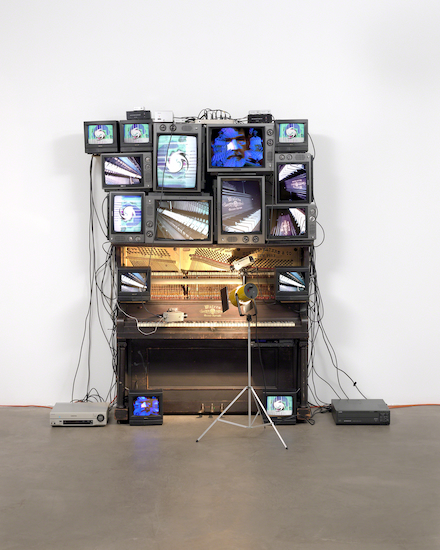 |
| Nam June Paik, Untitled, 1993, player piano, 15 TVs, two cameras, two laser disc players, electric light and bulb, and wires, 254 x 266.7 x 121. 9 cm (100” x 105” x 48”) The Museum of Modern Art, New York, © 2026 Artist or Estate of Artist (MOMA-S1319)
|
This piece is a tribute to the late composer John Cage, completed the year following his death. The piano is programmed to play a composition by Cage. The 13 monitors show various images, including Cage, Paik playing the piano, Cage collaborator Merce Cunningham, babies, and live video of the piano. The self-playing piano and video help keep the composer's legacy alive.
Background
The idea of mixing media and integrating art into life itself was a central aspect of the Pop Art movement. Artists from several countries, including the US, sought ways to extend the art experience into a theatrical situation or total environment. The logical result was the Happening, a performance that, participating artists maintained, could take place anywhere, not simply in a theater or art gallery. The earliest performances happened in 1959 in New York. The inevitable extension of art existing as performance within a space was the documentation of such events.
For some artists in performance, the immediacy of direct contact with the audience was crucial. With the advent of the widespread use of television in the early 1960s, the new medium was quickly appropriated by some artists as a tool to either augment a performance with sound and music, or the be incorporated into other art forms as key elements. By the 1970s, when cheap video cameras were available readily, electronic documentation of performance, and incorporation of a myriad of types of filmed phenomena became essential to the practice of Conceptual Art.
Korean artist Nam June Paik was known for is innovative use of video and electronics in sculptures and installations. Combining moving images with sculptural compositions gave a performance-like quality to otherwise stationary artworks. Televisions are often incorporated into his work. Utilizing objects that were quickly becoming central to many peoples lives, Paik pushed the boundaries of what is considered art. Because of his efforts, video installation is an increasingly popular and accepted art form.
Paik was born in Seoul, but fled to Hong Kong when the Korean War (1950-1953) broke out. He graduated from Tokyo University in 1956 when went to Germany to study avant-garde music composition. There he met the avant-garde composer and artist John Cage (1912-1992). He became a member of the group Fluxus, a loose international collection of performance artists, visual artists and musicians whose manifesto, like that of the original Dada artists, called for the overturning of perceptions of physical art in favor of perceptions, both visual and mental. His first one person show in Germany was a groundbreaking arrangement of television that altered the look and content of conventional TV.
In 1964 he moved to New York, abandoning music as his major oeuvre in favor of television and video for its expressive purposes. In 1965 he was one of the first artists to use a camcorder. In 1969 he helped pioneer a vide0-synthesizer that allowed him to manipulate images from various sources. Cage's vision always influenced Paik.
Correlations to Davis programs: A Community Connection 2E chapter 6 intro; A Global Pursuit 2E lesson 9.4; Experience Art, lesson 7.5; The Visual Experience 4E lessons 9.3 and 9.4; Discovering Art History 4E lesson 17.6; Davis Collections – Asian-American Artists; Davis Collections – Media/Technology Arts; AP Art History, Content Area 10 -- Global Contemporary

Comments