June Drawing by Vincent van Gogh (1853-1890 France)
As an art historian, I tend to get a little giddy about details of works of art to which most people would not pay attention. Just as I got goosebumps when I saw the chisel marks in Michelangelo's (1475-1564) Pietá Bandini at the Duomo in Florence, I get equally as thrilled when I see the individual pen strokes by van Gogh in this gorgeous study for the Van Gogh Museum’s The Harvest. This drawing was produced in van Gogh’s very productive summer of 1888 in Arles.
A June Drawing by Vincent van Gogh (1853-1890 France, born Netherlands)
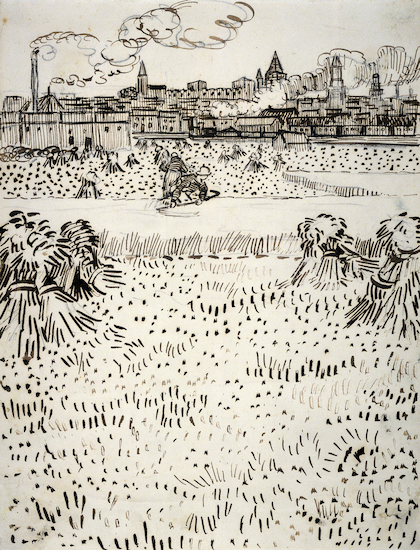 |
| Vincent van Gogh, The Harvest, 1888, brown ink over pencil on paper, 31.7 x 24.2 cm © 2026 National Gallery of Art, Washington (NGA-P0882) |
Van Gogh made many study drawings and executed a number of paintings pertaining the the wheat harvest on the plain of La Crau Plain near Arles in June of 1888. They resulted in the painting The Harvest at La Crau which is in the Van Gogh Museum in Amsterdam. He usually depicts the plain from a slightly higher ("bird's eye") view point in order to establish a sweeping panorama. This was the most productive period in van Gogh's short life, one during which he painted The Starry Night the same month as he executed this drawing.
Van Gogh's drawings contain the same exuberant strokes as his paintings. Echoing his brush work, van Gogh used short, quick strokes of a reed pen to build the forms in the drawing. In this way, he was making notes to himself on the direction of the brush stroke movement in the finished painting. This also created a lively, decorative drawing with a vitality that expressed the joy and solace he found in nature. The short, staccato pen strokes indicate the cut hay, while longer strokes delineate the mature wheat ready to be cut.
Van Gogh has established depth in overlapping horizontal bands, with the city of Arles establishing the background horizon line. It is evident that he used the church tower under the factory smoke as his vanishing point. The growing wheat on the right side of the composition converges on that point. The cut hay sheaves as well converge on that point in diminishing size.
Background
Vincent van Gogh was born and raised in Groot-Zundert, a bleak region in North Brabant, Netherlands. His father was a minister, and the family enjoyed a comfortable lifestyle. He was a sensitive young man interested in painting, who suffered from bouts of depression. He grew up amidst grinding rural poverty, so at first he attempted a number of other careers. He was an art dealer, school teacher, bookshop clerk, and theology student.
While he was a missionary to coal miners in Belgium, van Gogh made numerous drawings of the poor people around him. After three years, he returned to the Netherlands. His dream to create paintings that could emotionally touch his fellow humans finally persuaded him to concentrate on a career as an artist. Moving into a studio in The Hague in 1882, he began to focus on making art his full-time vocation.
Van Gogh was largely self-taught. He concentrated first on perfecting his drawing and perspective skills in black and white sketches of figures and scenes of rural life. He was initially influenced by the Realists, particularly Jean-Francois Millet's (1814-1875) scenes of rural peasant life, which accounts for his early decision to paint genre scenes of the rural poor. Van Gogh’s early works were meant to inform the viewer about the harshness of such a life.
He made studies of people and scenes, and produced paintings that were copies of other artists’ works. He also studied in Antwerp, Belgium, enriching his dark somber palette with the brighter colors he had never seen in the work of Flemish Baroque painting. At the age of thirty-three, van Gogh moved to Paris to live with his brother, Theo.
Surrounded by artists in Paris, van Gogh began to develop his style in earnest. Inspired by the works of Claude Monet (1840-1926) and Édouard Manet (1832-1883), van Gogh gradually abandoned his dark palette in favor of the pure, bright colors of impressionists. From post-impressionists such as Camille Pissarro (1830-1903) and Georges Seurat (1859-1891), he assimilated a short, expressive brush stroke. His formative period in Paris was followed by a productive year in Arles, in southern France, near the Mediterranean.
Correlations to Davis programs: Explorations in Art 2E grade 1, lessons 1.2, 4.4, 4.5; Explorations in Art 2E grade 4, lessons 1.7, 1.9, 3.1, 3.2, 4.5; Explorations in Art 2E grade 6, lessons 2.1, 2.3; A Global Pursuit 2E lesson 6.1; A Personal Journey 2E lesson 5.4; Experience Art lessons 4.1, 4.2; The Visual Experience 4E lessons 8.1, 8.13; Discovering Drawing 3E chapter 4

Comments