Artist Birthday: Jess (Jess Collins, 1923-2004 US)
Jess was a truly unique and versatile artist in many art forms. He is best known for his incredibly complex collages, but that does not even scratch the surface of his amazing body of work. He was truly a fabulous late 20th century Surrealist artist. Did you ever hear of Neo-Dada in the 1960s? Well, this is it.
Artist Birthday for 6 August: Jess (Jess Collins, 1923-2004 US)
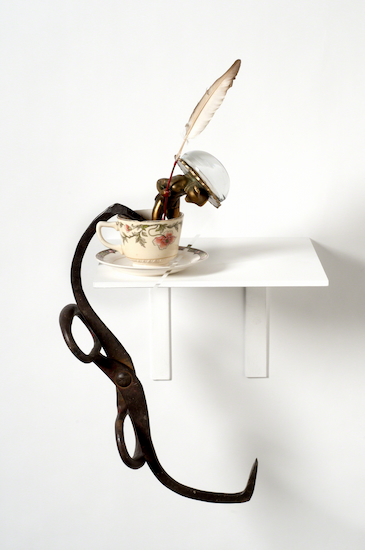 |
| Jess, Stir-Up Cup, 1963, ceramic, ice tongs, paper, feather, paint, height: 57.2 cm Philadelphia Museum of Art, © 2026 Artist or Estate of Artist (PMA-6757) |
As Jess forged a new a life of creative, intellectual, and social freedom in San Francisco during the 1960s, his art-making spilled over into home-making. Jess and and his partner, Robert Duncan, embraced their domestic sphere and through it forged a tight-knit community of artists, poets, and musicians with open interpretations of what art could be and a radical conception of what art could be. Central to Jess's practice with what he called "assembly" — for conceptual, as well as financial, reasons — was the practice of scavenging for the raw materials of art making. By re-claiming objects, images, and language, then re-assessing, re-arranging, and re-contextualizing them, Jess transformed everyday junk and hidden treasures into talismanic objects, loaded with potential meaning and humor. (Text by Hofstedt Gallery, San Francisco)
Background
On the eve of developing Cubism with Pablo Picasso (1881-1973), Georges Braque (1883-1962) saw faux wood grain pattern wallpaper in a shop. He adhered this to charcoal drawing compositions creating the first collages (called papier collé or “pasted paper” in French). After Picasso saw these he immediately created 100 collages himself. Progressive modernist artists in Paris, and the Italian Futurists (an offshoot of Cubism) soon eagerly immersed their bodies of work in the new art form. Collage also had a major impact on the Russian modernist Suprematism and Constructivism movements.
Collage because one of the major art forms of the movements of Dada and Surrealism, anti-establishment movements inspired as critiques of Western culture after the horrors of World War I (1914-1918), fitting in with their anti-art and found-object aesthetic. Late in his career, Henri Matisse (1869-1954) put a new spin on collage with his cut paper compositions that were his primary medium.
After World War II (1939-1945), collage became a mainstream art form in Western art. It was popular with many of the Abstract Expressionists in the 1950s and 1960s, and was also adopted by West Coast modernists who stressed in their work in “finding” the “magic of unknown things.” Into the 21st century, collage has remained a vital art form often combined with found object. It is particularly important in the contemporary principles of appropriation and hybridity that define many contemporary art works.
Jess was born in Long Beach, California. One of his pastimes as a child was making scrapbooks with his great aunt, which he credited as one of the origins of his adult collage work. During World War II he had a minor role in the Manhattan Project which developed the nuclear bomb.
From 1945 to 1948 he took adult art classes while working as a radiochemist. He left that job, moving to San Francisco to become a full-time artist, studying at UC Berkeley, California School of Fine Arts, and San Francisco Art Institute. At Cal Arts he came under the influence of color field painter Clyfford Still (1904-1980) and subsequently explored both abstraction and figuration.
In 1950 Jess met poet Robert Duncan (1919-1988) who became his lifelong partner and collaborator, who introduced him to the Surrealist collages of Max Ernst (1891-1976) which prompted Jess to make collages starting in the early 1950s, which he called “paste-ups”. Starting in 1959 Jess explored a series of paintings combined with collage, which were combined with literary texts from a wide variety of authors, including Gaelic songs, Aztec and Mayan poetry, and works by Plato (429?-347 BCE).
Jess lived and worked in San Francisco the rest of his life. His first solo show was in 1950, and he became widely known in group exhibitions throughout the country. His work is in many major museums, including the Museum of Modern Art New York, Whitney Museum New York, National Gallery of Art Washington, and the Metropolitan Museum of Art New York.

Comments