July is World Watercolor Month
I do not think I need to go into my sob story about how inept I am with watercolors. You know how bad I was? One of my instructors in grad school suggested I stick with oils because I was trying too hard to imitate those qualities with watercolor. Harumph. On top of that, did you ever think of watercolor in a big way in the oeuvre of Albrecht Dürer (1471-1528 Germany)? Neither did I, until I saw this gorge little landscape. If any art form deserves a world dedicatory month, it’s WATERCOLOR. Artist and illustrator Charlie O’Shields (born 1971) helped found World Watercolor Month in 2016. He created a website and social artist movement dedicated to promoting and bringing together the vast community of watercolor artists around the world.
July is World Watercolor Month, art by Albrecht Dürer (1471-1528 Germany)
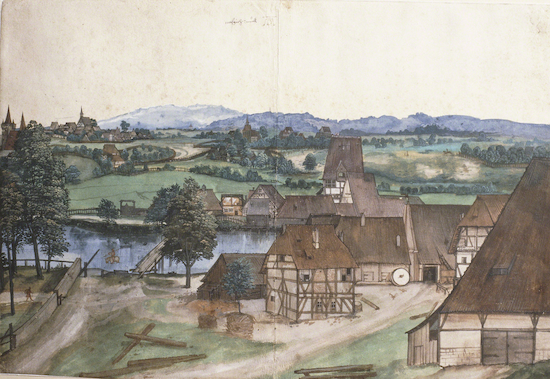 |
| Albrecht Dürer, The Wire-Drawing Mill, 1489-1490, watercolor on paper, 29 x 42.6 cm (11 7/16” x 16 3/4") Gemaeldegalerie der Staatmuseen zu Berlin, Germany, Photo © 2026 Dr Ron Wiedenhoeft / Saskia, Ltd. (LGM-0010A) |
In 1486, Dürer was apprenticed to the most prominent painter in Nuremberg, Michael Wohlgemuth (1434-1519), from whom he certainly learned the basic essentials of painting. The only works remaining of Dürer's years with Wohlgemuth are a series of watercolors of the vicinity of Nuremburg, including the Wire-Drawing Mill. It is remarkable not only because it is one of the earliest stand-alone landscape by the artist, but also for his incredible fealty to nature, perspective, light. This watercolor was executed before his Wanderjahr (year of wandering) when he visited Italy for the first time and would have seen paintings with the "new perspective" (linear one-point perspective), which is expertly executed in this view. Spatial relationships are brilliant, as is Dürer's use of atmospheric perspective in the depiction of the distant mountains. This watercolor is a testimony to the inherent genius and acuity of Dürer's artistic vision.
Background
Just as the rising prosperity of the merchant class had created a new class of patrons of art during the 1400s in Flanders, thus spawning the Renaissance in northern Europe, the same was true in the Germanic States. Present day Germany and Switzerland were part of a loose confederation of states called the Holy Roman Empire.
Established with the coronation of Charlemagne by the pope in Rome in 800, the Holy Roman Empire lasted, more or less uninterrupted until the 1700s, with an emperor ruling from Germany. Artists guilds flourished beginning in the 1300s and trade flourished under the auspices of the Hanseatic League, a group of cities and trading outposts that stimulated trade and enriched a growing merchant class.
During the 1400s, Germanic Renaissance art was of two stylistic types: one was a continuation of the International Style, which emphasized rich surfaces, pattern, elongated figures, softness of contours and sweetness of expression. The second type was artists who emphasized an intense investigation and detail expression of the physical world. The interest in physical realism eventually dominated, spurred on by the intense realism, atmospheric space and secular emphasis of Flemish art.
Like many of the masters of the Italian Renaissance such as Leonardo and Michelangelo, Albrecht Dürer was an artist whose interest transcended painting and drawing to science, engineering, and design. Born in Nuremberg, he began his artistic training as a draftsperson in his father's goldsmith shop, designing products and decorative motifs that would be incised into the objects. Printmaking is thought to have evolved from pattern books for armorers who inked and printed their designs for incised decoration on parade armor.
Dürer subsequently trained for three years in the shop of painter and printmaker Michael Wohlgemut beginning in 1486. After his apprenticeship ended in 1489, he visited other printmakers in the Netherlands and Germany, including the Housebook Master in the middle Rhine. His painting style was greatly formed during his first trip to Italy in 1494. While in Italy he immersed himself in classical art and the new humanism. He is also thought at this time to have studied artists who based figure construction on geometry. This may have led him to later publish his own theories about the mathematical relationship to painting.
Correlations to Davis programs: Explorations in Art 2E grade 2, lessons 1.4, 1.6; Explorations in Art 2E grade 3, lesson 5.6; Explorations in Art 2E grade 4, lesson 3.1; Explorations in Art 2E grade 6, lessons 2.2, 2.3; A Global Pursuit 2E lessons 4.4, 7.2; A Personal Journey 2E lessons 5.2, 5.5; The Visual Experience 4E lesson 8.13; Experience Art lesson 4.1; Experience Painting pp. 93-107; Discovering Art History 4E, lesson 10.2

Comments