National Native American Heritage Month, art by Ancestral Pueblo Culture
All over the world, cultures and countries are able to see their history in the ruins of ancient buildings and cities. That is certainly true in the US, where the ruins of ancient indigenous cultures are still around to be seen and admired. Native American Heritage Month was established in 1990 by decree of President Bush. I think the ancient ruins of the Pueblo ancestral cultures of the West and Southwest are pretty impressive. I have visited many of the sites, and one gets goosebumps just the same as one does when standing in the midst of ancient Roman ruins…those goosebumps are the ghosts of past civilizations.
November is National Native American Heritage Month, art by Ancestral Pueblo Culture
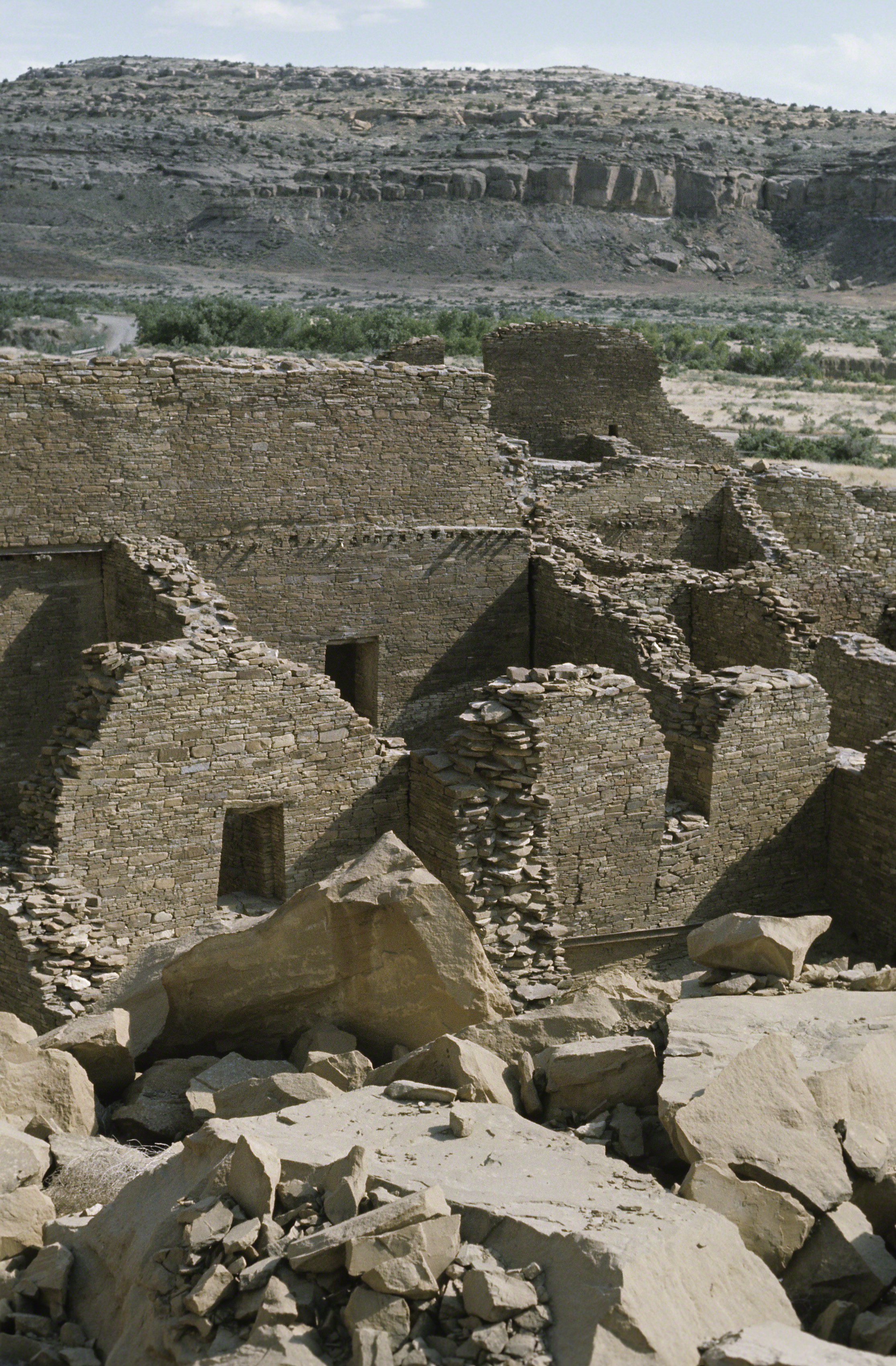 |
| Anasazi Ancestral Pueblo Culture, Pueblo Bonito, Chaco Canyon, NM, 1000s CE Image © 2026 Davis Art Images (8s-11493)
|
Some of the most magnificent examples of Anasazi architecture are in Chaco Canyon, New Mexico. Within a fifteen kilometer (9.32 mile) range there are nearly 300 separate apartment buildings, some on the valley floor and some on top of the mesa. Pueblo Bonito, the grandest of all of these was built in a semi-circular form.
Pueblo Bonito achieved its final form around 1100. It may have had as many as 800 rooms. Some of the buildings were as tall as five stories. The masonry was finely cut sandstone, with floors composed of pine beams bound with mud and plaster. The wide walls at the lowest level were able to support multiple stories. The multiple stories buildings are visible in the background of this image.
Visible in the foreground are the circular kiva. The semi-circular subterranean pit houses of Anasazi past are preserved in the kiva form. In some Anasazi apartment complexes the kivas are relatively small. Those visible in the foreground of this image at Pueblo Bonito are huge and must have been used as ceremonial gathering plazas for hundreds of people.
The metropolis at Chaco Canyon served as a regional hub and ceremonial center for a wide-reaching economy. Shells from California, copper bells and live tropical birds from Mexico all passed through Pueblo Bonito. Many roads, up to several meters wide, radiate out of Chaco Canyon, some in a straight line for as far as 80 meters (almost 50 miles). Pueblo Bonito, with its close-knit living quarters, communities of small rooms punctuated by large spaces, shows a communal organization that is still important to the Pueblo people to this day.
Background
Evidence of the Anasazi culture exists in the region of the Four Corners (where the borders of Utah, Colorado, Arizona, and New Mexico meet) as early as 1500 BCE. The Anasazi are believed to have evolved from hunter-gatherers into farmers around 100 BCE. Various types of domesticated plants from Mexico, such as corn, squash, and beans, had been introduced around 200 BCE.
The Anasazi were dry farmers and relied on the unpredictable rainfall for growth of crops. In approximately 500 CE, when more reliable farming techniques developed, the Anasazi became sedentary town dwellers. Archaeological evidence from sites in Chaco Canyon indicates that Anasazi groups foraged the open grasslands during most of the year and returned to sheltered canyon dwellings during the winters.
The Anasazi were a very organized culture. They established roads and created platforms in their communities from which signals could be sent to neighboring communities. They also had an extensive trade network that extended to Mexico and the eastern Plains. Anasazi pottery fragments have been found as far east as Ohio. By far their most significant achievement was their use of stone and adobe construction to build large communal, aboveground dwellings, predecessors of the pueblo.
Anthropologists often divide Pueblo prehistory into chronological periods: Basketmaker II (1000 BCE–450 CE); Basketmaker III (450 –700 CE); Pueblo I (700–900 CE); Pueblo II (900–1100); Pueblo III (1100–1300) and Pueblo IV (1300–1600). The historic period, which dates from 1600 to the present, is known as Pueblo V.
Correlations to Davis Programs: Explorations in Art 2E grade 1, lesson 5.3; Explorations in Art 2E grade 2, lessons 6.1, 6.4; Explorations in Art 2E grade 3, lesson 4.2; Explorations in Art 2E grade 4, lessons 3.5, 3.8, 3.9; Explorations in Art 2E grade 5, lesson 2.8; Explorations in Art 2E grade 6, lesson 4.2; Experience Art 5.3

Comments