International Chef Day: art by Chaim Soutine (1893-1943 France, born Belarus)
International Chef Day was established by the World Association of Chefs’ Societies in 2004 to celebrate the culinary profession and to encourage chefs to pass on their knowledge to the next generation — particularly around healthy cooking and food education for children.
October 20 is International Chef Day: art by Chaim Soutine (1893-1943 France, born Belarus)
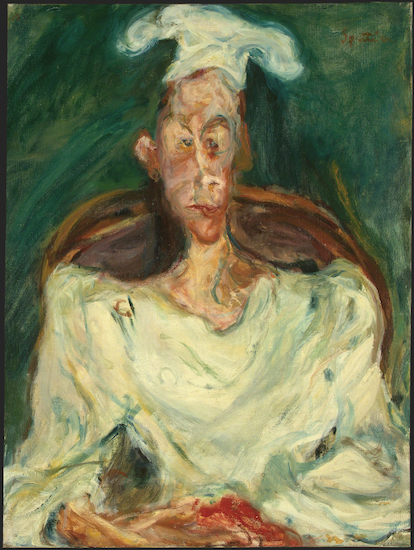 |
| Chaim Soutine, Pastry Chef, ca. 1923, oil on canvas, 64.5 x 48.3 cm National Gallery of Art, Washington, © 2026 Artists Rights Society (ARS), New York (NGA-P0937stars) |
Soutine's paintings are garish, distorted and often dominated by a certain sense of melancholy. These traits surely hold true with his portraits. Among his most amazing groups of works are his portraits of hotel staff from fashionable restaurants and hotels of 1920s Paris. Pastry Chef (from a restaurant) comes from this group. Soutine executed many portraits of pastry chef's, many of them boys. Pastry Chef's features are too distorted to associate this work with a specific individual.
This is a characteristic of many of these portraits. The eyes are at different levels, faces are exaggeratedly asymmetrical, and skulls are elongated and distorted. Oddly, in his Pastry Chef portraits, several of them hold a bright red rag in front of them. In this iteration of the subject, the red rag hides one of the chef's hands almost as if it is a bloody piece of meat, or cut off hand.
Although features of sitters such as Pastry Chef's are distorted to the point where psychological analysis of the sitter is impossible, Soutine's preoccupation with these workers indicates a respect and interest in these peoples' humdrum, hardworking lives. The uniforms in these hospitality industry portraits are keys not only to their jobs, but also become the vehicle for the works' palettes.
Soutine tended to favor carmine red, pthalo blue and chromium oxide (green). Green and pthalo blue permeate Pastry Chef, through his uniform, skin and background. Like Cézanne, Soutine presents all of his sitters in a straightforward, full frontal view in a shallow space, a posture which seems to emphasize a certain feeling of being trapped. Ironically, for all of Soutine's interest in these people, none of the paintings are titled with their names, the uniform is their only identity. Maybe they are meant to elicit a certain empathy by the views through their anonymity.
Background
Expressionism is a term for a movement first applied to art from the early part of the 1900s, primarily from northern Europe, especially Germany. It was a style that allowed the artist to articulate the stresses of modern life. Artists working in the Expressionist style believed that the form of the work of art grew out of content. In other words, jarring color, jagged line, and dramatic composition were critical to expressing the artist’s solemn, passionate, sometimes violent, innermost vision. Key influences on expressionism were German Renaissance woodcuts, Mannerism, and the work of van Gogh.
Chaim Soutine was a member of a subgroup of artists in Paris called Les Maudits (the cursed) in French. The term referred not only to their poverty and alienation as artists, but also because of their disorderly and ultimately unhealthy lifestyles. Soutine came from a poor Jewish family in Belarus. He rebelled at 14 and attended the Academy of Fine Arts in Vilnius, Lithuania.
By 1911 he had settled in Paris. Although he attended classes at the School of Fine Arts there, it was through meeting other artists in La Ruche tenement in Montparnasse that he began to focus on a developed style. Because he destroyed or reworked many of his paintings, it is difficult to trace the path to his mature style. Early formative influences were the work of Paul Cézanne (1839-1906), and, naturally, Vincent van Gogh (1853-1890). He also had a passion for Rembrandt (1606-1669).
Soutine worked passionately and intensely on his paintings. He could never detach himself from the memories of the hardships he suffered in Lithuania. Obsessed with form and color, and often plagued with bouts of dissatisfaction and depression, he destroyed many of his own works. The majority of his works were produced between 1920 and 1929. In 1920 the wealthy American collector Arthur Barnes bought sixty of his paintings, allowing Soutine to work relatively free from financial concerns.

Comments