Hispanic American Heritage Month Continues until 15 October
Rosa Ibarra was born in Puerto Rico, spent her childhood in Old San Juan, and went to high school in Paris. Her paintings have been exhibited in numerous galleries across the country and abroad. Ibarra’s work focuses mainly on women and children. Inspired by the subtle beauty of a soft facial expression, the radiation of strength, or a quiet moment of contemplation Ibarra conveys the unique nature of humanness.
Hispanic American Heritage Month Continues until 15 October
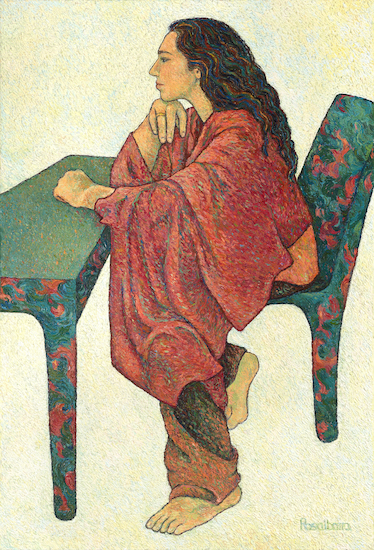 |
| Rosa Ibarra, Seated Muse, from the series The Seated Muses, oil on canvas, 81.3 x 55.9 cm (32” x 22”) Image Courtesy of the Artist, © 2026 Rosa Ibarra (8s-30641)
|
Ibarra’s paintings are complex combinations of rich personality, rich color, and rich surface. Inspired by people – especially strong women – she learns the most while observing her subjects in natural poses. Many of her portraits and images of women are tributes to women who have given their all to raise children and help others do the same, and have an inner emotional strength, i.e., stories not told by other artists. Her paintings elevate these unpresuming people in compositions where Ibarra adheres other elements to the oil painting to create a relief surface and contrast to the brush work. Ibarra decides on what materials to adhere based on the sitter’s personality.
Ibarra created several versions of The Seated Muse. They are both allegorical as well as actual portraits of real people. In Mari, Ibarra demonstrates her preoccupation with the creation of an interesting, lively surface, whether it is through the use of found sea glass and other natural detritus, or through her brush work. The figures are created from a complex, “knitted” pattern of narrow strokes of brilliant color that resemble pointillism. They have a solid presence that is visually as exciting as the materials she adheres to her paintings.
She builds the form from a complex combination of "stitches" of paint that are very similar to the work of Vincent van Gogh (1853-1890), whom she claims as an influence to her work. Particularly in the undulating, moving waves in Mari's hair the similarity to van Gogh is quite clear. In the complex layering of paint, she builds a texture on the surface of the canvas that rivals that of her use of sea glass and other applied materials.
Background
Artists in the 21st century have – more than ever before in art history – unprecedented number of ways of expressing their artistic vision. There are no longer “official” academies to dictate to artists how their work should look or what it should say. Some artists use graphic, violent or other provocative visual means to get across their personal vision. Others use quiet, subtle ways of expressing the inner fire behind their works.
Rosa Ibarra is a Puerto Rican painter of people and portraits, mostly of women and children. She is inspired most by innocuous aspects of humanity: a gesture, a contemplative moment, a radiation of strength, or a quiet moment of connection between two people. Ibarra was born in Old San Juan Puerto Rico into a family of artists. Her father was internationally renowned painter Alfonso Arana (1927-2005), and her grandmother was a writer. She trained in painting in her father’s children’s art classes. After receiving a degree in fine art from University of Massachusetts, Amherst, she trained further in her father’s Paris studio, acting as his assistant.
Ibarra feels that art is what she was meant to do, and she shares her personal passion for both people and painting with marginalized communities in many social projects such as illustrating children’s books written by male inmates, teaching painting to cancer survivors, neurodiverse people and recovering addicts, and presenting art to young women in prison. She is committed to the idea that art can touch people’s spirit at any age, either passively or actively.
In 2013 she was selected by the US Department of State’s “Art in Embassies” program to conduct workshops and lectures. She taught painting to teenagers recovering from drug and alcohol abuse in Latvia, lectured at the Art Academy of Latvia in Riga, and painted with three- to twelve-year-old children in an orphanage there. Typically, the use of outline helps to unify the composition.
Correlations to Davis programs: Explorations in Art 2E grade 1, lessons 2.1, 2.2, and 2.3; Explorations in Art 2E grade 2, lessons 2.1, 2.2, and 2.6; Explorations in Art 2E grade 3, lessons 1.1, 1.3, and 1.4; Explorations in Art 2E grade 4, lessons 1.1, 1.2, and 2.1; Explorations in Art 2E grade 5, lessons 1.1, 1.2, and 1.7; Explorations in Art 2E grade 6, lessons 1.1, 1.2, 1.3, 1.4; A Global Pursuit 2E lesson 5.1 and 5.5 studio time; A Personal Journey 2E, lessons 2.1 and 2.3; Experience Art lessons 2.1 and 3.1; The Visual Experience 4E lesson 10.3

Comments