Heat Equals Warm Colors: Art by Karel Appel (1921-2006 Netherlands)
What with the warm weather we experienced recently, the steaminess put me in mind of how works of art can reflect warmth or coolness, or in terms of the latest weather: Heat. Just look at this fiery landscape by CoBrA artist Karel Appel, whose motto was "abstraction for abstraction’s sake", with plenty of impasto at that. Even if it has cooled down where you live, just stare at this fabulous painting for a little bit and the heat will come back to you.
Warm Colors Means HEAT: Art by Karel Appel (1921-2006 Netherlands)
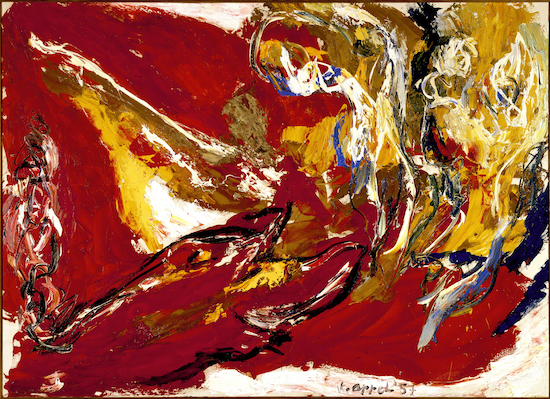 |
| Karel Appel, Life in a Red Landscape, 1957, oil on canvas, 152.4 x 206.4 cm (60” x 81 1/4") The Museum of Modern Art, New York, © 2026 Artists Rights Society (ARS), New York (MOMA-P5066apars)
|
Although Appel's works often verge on total abstraction, such as Fire World, his works rarely did not correlate to something in the physical world. Consistent in his body of work is the use of bold color, expressionistic brush stroke, and heavy impasto (build-up of paint). CoBrA artists are often compared to American Abstract Expressionism because of the rejection of stale, geometric modernism. However, the American group was more influenced by the automatic creative process of Surrealism and the primacy of process, rather than the search for a significant inner vision expressed in paint. Appel claimed that painting required learning which then needed to be forgotten so that expression came from the heart.
Background
After World War II (1939-1945), many of the European artists who had fled to America for the period of the war returned there. Many of them continued to pursue abstraction as they had before the war. Others were interested in reviving the exploration of figuration. This is a repeat of what had happened after World War I (1914-1918), when even some of the major pioneers of abstraction, such as Pablo Picasso (1881-1973), had returned to the figure. The duel between abstraction and figuration for primacy continued unabated in Europe after the war.
In the post-war Netherlands, modernist artists finally tired of the geometric, Constructivist abstraction of De Stijl that had dominated art since the 1920s. Three artists, Karel Appel, George Constant (1892-1978) and Cornelis Corneille (1922-2010), established the Experimental Group in 1948. They wanted to explore new forms of expression that rejected both the style of Piet Mondrian (1872-1944) and the stale academic tradition. The group evolved with artists from Belgium and Denmark to CoBrA (standing for Copenhagen, Brussels and Amsterdam).
Many of the CoBrA artists explored expressionistic figuration, much like the art of Jean Dubuffet (1901-1985). Like Dubuffet, they too were influenced by the art of Visionary artists, children's art, and disabled and neurodivergent artists. There was no doctrine, save for the idea of unrestrained experimentation. Their work is characterized by emphasis on brush gesture and jarring color.
Karel Appel, born in Amsterdam, executed his first painting with he was 14. At 15 he received paints and an easel from an amateur painter uncle who also gave him lessons. At 19 he studed art 1940 to 1943 at the National Academy of Painting of the Royal Academy of Fine Arts, both in Amsterdam.
In his work of the immediate post-World War II (1939-1945) period, Appel's work was influenced first by the Cubism of Picasso and then by the colored shapes of Matisse. Ultimately, the biggest influence of his work was Dubuffet. Early works in a freer, more expressionistic style included painterly images of figures and animals, usually bounded in black contour lines. After befriending Asger Jorn (1914-1973), Appel's forms became even more liberated, to the point of total abstraction.
Correlations to Davis programs: Explorations in Art 1E grade 3, lesson 2.9; Explorations in Art 2E grade 1, lessons 3.5 and 4.5; Explorations in Art 2E grade 2 lessons 1.4, 1.5, 1.8; Explorations in Art 2E grade 3, lessons 2.7 and 5.9; Explorations in Art 2E grade 4, lessons 3.2, 4.4, and 4.5; Explorations in Art 2E grade 5, lesson 6.4; Explorations in Art 2E grade 6, lesson 2.4; Experience Art lesson 8.13; The Visual Experience 4E lesson 4.1; Exploring Visual Design 5E, Chapter 4, lessons 4.2, 4.4;

Comments