
Happy Summer: Art by Edward Potthast (1857-1927 US)
I’m not sure I’d want to loll around on a beach in street clothes, but, there is definitely something very relaxing about spending a day at the beach! And there is something very soothing looking at American Impressionist painting. Wishing all of you a happy summer!
Happy Summer: Art by Edward Potthast (1857-1927 US)
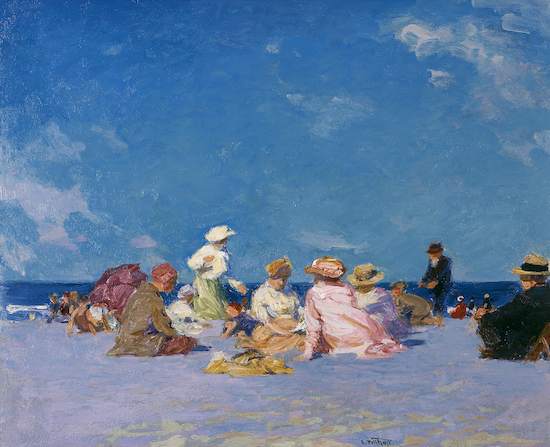 |
| Edward Potthast, Afternoon Fun, oil on canvas, 60.9 x 76.2 cm (23 5/8” x 30”) © 2026 Butler Institute of American Art, Youngstown, OH (BIAA-256)
|
With only modest success in Cincinnati, Potthast moved to New York in 1895. After moving to New York, he established one of the main genres of his mature body of work, scenes of people enjoying the beach, and rocky coastal scenes bathed in sunlight. He spent summer months in a number of seaside art colonies in the Northeast, including Gloucester, Rockport, Provincetown, Ogunquit and Monhegan Island. His love of the beach and its bright light on colors was such that, while in New York, he would often paint outdoors on Coney Island or Rockaway.
Background
During the late 1700s and early 1800s in the US, artists who wished to improve their abilities primarily travelled to Britain to study with both British and ex-patriate American painters to learn the leading styles of Europe. After the American Civil War (1860-1865), American artists continued to look to Europe as a nurturing ground for artistic training.
By the late 1800s, it was Paris and Munich that drew most American painters and sculptors. Americans who studied in Munich were trained in the painting techniques of Dutch and Spanish Baroque. The style of painting that evolved among the American ex-patriates, led by a teacher from Cincinnati Frank Duveneck (1848-1919) eventually came to be known as Dark Impressionism.
Edward Potthast was born in Cincinnati and, at age 12, became a charter student at the McMicken School of Design, now the Art Academy of Cincinnati. He was initially trained by a portrait painter who had been a pupil of the French Barbizon Realist landscape and genre painter Thomas Couture (1815-1879). This instilled in Potthast a dark palette and fluid, painterly surface. In 1881 Potthast made his first trip to Europe, ending up at the Royal Academy in Munich, Germany. Munich had been the destination of many other artists from Cincinnati before Potthast.
Potthast studied at the academy under the portrait painter Carl von Marr (1858-1936) who school him in adeptly depicting light in his paintings. Before returning to Cincinnati in 1885 he studied six months at the Academie Julian in Paris, where many of the Impressionists had studied during the 1860s.
In 1886 Potthast again went to France, and spent time painting in the American painting colony of Grez, where he met Robert Vonnoh (1858-1933) an Impressionist in the manner of Claude Monet (1840-1926), and Roderic O'Connor (1860-1940), an Irish Post-Impressionist who painted in the spirit of Vincent van Gogh (1853-1890) with slashing brush work and brilliant color. Potthast's time with the Grez colony profoundly impacted his palette. Upon his return to Cincinnati the light-filled, brilliantly colored canvases he brought back with him were proof of his total conversion to Impressionism.
Correlations to Davis programs: Explorations in Art 2E, grade 1, lessons 2.5, 3.4, 5.4; Explorations in Art 2E, grade 2, lessons 2.4 and 2.5; Explorations in Art 2E, grade 3, lesson 1.5; Explorations in Art 2E, grade 4, lesson 4.4; Explorations in Art 2E, grade 5, lesson 1.7; Explorations in Art 2E, grade 6, lessons 1.4, 6.4; A Community Connection 2E lesson 2.1; A Global Pursuit 2E lessons 5.1 and 6.1; A Personal Journey 2E lesson 2.1; Experience Art lessons 2.1, 5.1

Comments