Gem of the Month for September: Tone Vigeland (1938-2024 Norway)
Did you ever go “Wow!” when you see a certain work of art (something I do probably on a daily basis)? Well, that’s what I did when I saw the stunning jewelry by Tone Vigeland. She has got to be one of the most unique jewelry artists I have ever seen. And the more of her works I see, the more “Wow!”s come out of me (oh, that rhymes).
Gem of the Month for September: Tone Vigeland (1938-2024 Norway)
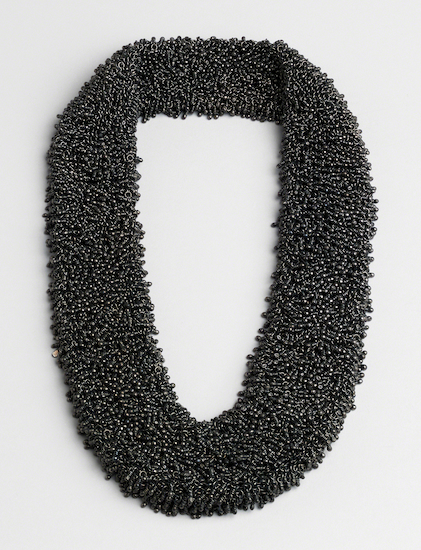 |
| Tone Vigeland, Necklace, 1986, sterling silver, 8 x 28 x 8 cm (3 1/8” x 11” x 3 1/8”) The Museum of Modern Art, New York, © 2026 Tone Vigeland/Artists Rights Society (ARS), New York (MOMA-D0741vgars) |
Vigeland’s jewelry designs were first introduced in the US in 1983. Her extraordinarily complex constructions of her jewelry was an instant hit in the US. One of her trademark processes is what she calls “bangles”. She introduced her Viking flavored jewelry to America in 1983 with a one person exhibition. This necklace is a masterful construction of woven silver wires with their ends balled up from heat. The construction is soft and pliable
Background
Contemporary jewelry, in its basic sense, is an object of adornment that is intended by the artist to transform the wearer. Jewelry contains an authority well beyond its component parts and this ability to transform the wearer makes it a rich, intimate and exciting art form. The transition of jewelry-making from "craft" to fine art had its beginnings in the Western world during the last three decades of the 1800s with the advent of the Arts and Crafts Movement. Arts and Crafts artists advocated for a return to hand-made decorative arts (jewelry, ceramics, and furniture, for example) as opposed to industrially machine-made, mass-produced objects that began to proliferate during the 1800s' made dash towards industrialization. The goal was to instill these art forms with a fine art aesthetic.
Since the 1960s, boundaries of jewelry have been continually redefined. Jewelry conventions have been challenged by successive generations of artist/jewelers who are often college-educated in fine arts. New technologies and non-precious materials -- such as paper, plastics, and textiles -- have dispelled the conventional perception of jewelry as an indication of status. Avant-garde artist/jewelers have explored interaction of jewelry with the body, increasing scale and wearability to their limits within the conception of jewelry as "wearable art."
Tone Vigeland was born into an artistic family in Oslo, Norway. She began her artistic education in metalworking at the National Academy of the Arts, Oslo in 1955. In 1957 she studied goldsmithing at the Oslo Vocational School. In 1958 she joined the avant-garde artists' group PLUS in Frederikstad where she produced some of her first iconic pieces of jewelry. A pair of earrings worked from a single loop of silver were successfully produced until 1985. From 1995 Vigeland has explored sculpture and installation in the same materials as her jewelry, including nails, stone, lead, steel, silver wire and piano wire.
Correlations to Davis programs: Explorations in Art 2E grade 2, lesson 2.7; Explorations in Art 2E grade 6 lesson 5.7; A Community Connection 2E lesson 5.2; A Personal Journey 2E unit 7 Careers; The Visual Experience 3E lesson 10.7; The Visual Experience 4E lesson 10.11

Comments