'F' is for Fabulous Fauve Fall by Maurice de Vlaminck (1876-1958 France)
Since I do not stick to colors found in nature in my landscapes (non-local color in art history words), and, since looking at vibrant color in paintings is one of my addictions, you might figure that I would feature a Fauve artist for a blog about Autumn. Of all the early modernist styles that developed before World War I (1914-1918), Fauvism is one of the clearest paths to total abstraction when the artists emphasized non-local color. I prefer such an aesthetic in landscapes rather than as a green stripe down someone’s face (yes, you Matisse).
Autumn is Still Here: Just check with Maurice de Vlaminck (1876-1958 France)
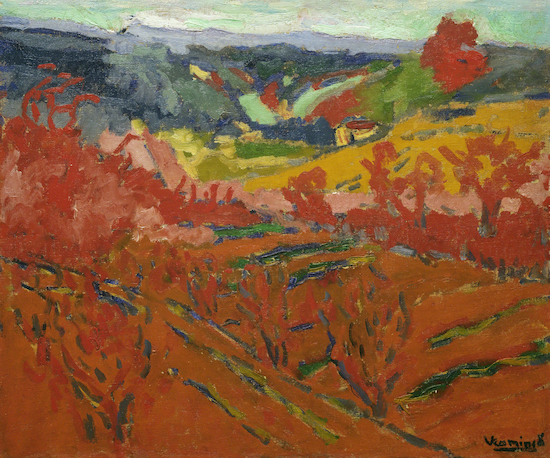 |
| Maurice de Vlaminck, Autumn Landscape, ca. 1905, oil on canvas, 46.2 x 55.2 cm (18 3/16” x 21 3/4”) The Museum of Modern Art, New York, © 2026 Artists Rights Society (ARS), New York (MOMA-P2244vlars)
|
From the beginning of his career, he was engrossed with bright color. A show of van Gogh's work in Paris in 1901 confirmed this, and van Gogh remained his greatest inspiration through his Fauve period. Although he met Matisse in 1901, his painting did not achieve its full Fauvist potential until 1905. Characteristic of his Fauve works are the short, choppy brushstrokes typical of van Gogh's work. They give Vlaminck's Fauve works a dynamic energy that approaches Expressionism.
Fauve artists built on past uses of color to indicate depth. In this work, Vlaminck's foreground is dominated by warm reds. It contains complementary touches of blue and green that echo the distant background's cool colors. The use of blues, purples and greens to indicate great distance was similar to the atmospheric perspective developed by Northern Renaissance painters in their landscape backgrounds of the 1400s.
Background
The beginnings of modernism in 1900s art began in painting with the French Impressionists in the late 1860s. They refused to be dictated to on how to paint and what subject matter to depict. The rejection of academic control over artists spread throughout the Western world. It became the advent of the idea of modern artists producing art for "art's sake" based on personal vision, rather than on commissions by patrons who dictated style and subject matter to them. This ideal flowered in the first two decades of the 1900s when style, subject matter, technique and even the very nature of art itself experienced major overhauls.
In the early 1900s, many artists were seeking even more liberation from traditional paintings than the Impressionists and Post-Impressionists had found. These artists, particularly Expressionists, sought to liberate painting from the strictures that bounded traditional subject matter. In order to liberate color from the past, they rejected any past associations in their painting of literary, romantic or narrative content. In essence, the subject became the vehicle for the expression of the artists’ love of pure, unbounded color.
The Fauves, a group of artists who exhibited together at the Autumn Salon (Salon d'Automne) in Paris in 1905, are sometimes referred to as the first modern art movement, in that they liberated color from form. They emphasized the artist's personal, emotional search for unique expression. They used the vibrant colors of Impressionism to make abstract shapes that composed their forms, foreign to the natural appearance of the subject. The movement was spearheaded by Henri Matisse (1869-1954) and André Derain (1880-1954).
Maurice de Vlaminck was born in Paris to musician parents of Flemish background. This fact may have been important to him personally and may have contributed to the exuberant nature of his painting. He was a self-taught artist who delighted in expressing contempt for the art in museums. He also claimed at one point to have been the leader of the Fauves and took part in the initial discussions about Cubism.
Vlaminck once stated that he had not originally intended to be an artist, although he took painting lessons from academic artists between 1888 and 1891. He also studied with a local, naive artist Henri Rigal (dates unknown) in 1893. He held multiple jobs to support his family before deciding to dedicate his life to painting after military service (1896-1900). His earliest paintings were decoration for a regimental party in 1899.
Vlaminck met Derain on a train in 1900. The two became friends and eventually shared a studio in Chatou, a suburb of Paris. It was Derain's Fauvist beginnings that pushed Vlaminck into Fauvism. He and Derain inspired one another by exploring greater disconnect between form and local color. When Matisse saw Vlaminck’s paintings in 1905, he was stunned by Vlaminck's unrestrained use of pure, bright colors. Vlaminck exhibited in the 1905 Autumn Salon where a critic called the room of Vlaminck, Matisse, Derain and the other of his circle the Cage aux Fauves ("Cave of Wild Beasts”), unwittingly giving a name to their movement.
Although Vlaminck was briefly interested in the Cubist experiments of Georges Braque (1882-1963) and Pablo Picasso (1881-1973), by 1915 like Derain he gradually retreated into representation. His reputation began to suffer as he withdrew further and further from the group of progressive artists in Paris. His paintings for the rest of his life are characterized by a kind of expressive realism.
Correlations to Davis programs: Explorations in Art 2E grade 1, lessons 4.5, 6.1; Explorations in Art 2E grade 2, lesson 1.8; Explorations in Art 2E grade 3, lessons 4.3, 5.5; Explorations in Art 2E grade 4, lessons 3.1, 3.2, 4.4, 4.5; Explorations in Art 2E grade 6, lesson 2.3; A Personal Journey lesson 5.4; The Visual Experience 4E lesson 8.13; Discovering Art History 4E lesson 14.1; Exploring Painting 3E pp. 154-156

Comments