Artist Birthday: Yves Klein (1928-1962 France)
During the turbulent post-World War II (1939-1945) years, it is no surprise that art movements arose – as they did after World War I (1914-1918) – that questioned the validity of entrenched conventional thinking, including in the arts. The Nouveau Réalisme and Fluxus groups in Europe are two examples of this anti-academic art impulse in 1960s and 1970s art forms of all types.
Artist Birthday for 28 April: Yves Klein (1928-1962 France)
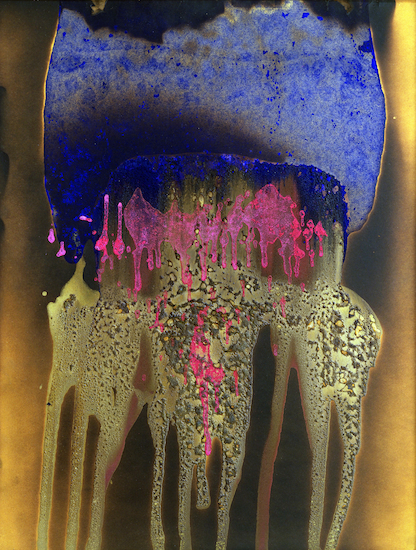 |
| Yves Klein, Untitled from the fire-color paintings, 1962, charred dry pigment in synthetic resin with metallic paint on asbestos-coated paper, mounted on board, 61.2 x 48.3 cm The Museum of Modern Art, New York, © 2026 Artists Rights Society (ARS), New York (MOMA-Po214kears)
|
Untitled is part of a series enabled by Klein's collaboration with France’s national gas company, which allowed him to capture the volatile power of fire visually, while having control over the combustion process. Klein created patterns of soot by scorching the surface with a flamethrower. The ritual physicality (with a large blowtorch) needed to create this work embodies the concepts, actions, and gestures that for Klein lay within the immaterial domain ("void") of the spirit. He renders tangible fire as the element that changes the physical state of materials from solid to liquid to gas, making it an ideal metaphor for the passage from the material to the spiritual and for the cycle of life and death. His aim was to “register the trace of fire which has engendered this very same civilization. And this because the void has always been my constant preoccupation and I hold that in the heart of the void as well as in the heart of man, fires are burning." Text: Monica Espinel, MOMA
Background
After World War II (1939-1945), European modernist artists followed a variety of different avenues in artmaking. They were now able to confront what they viewed as the sources of the devastating war – materialism, militarism, nationalism, and consumerism. The US, with its dominant post-war economic and commercial power, provided the source for aspects of American culture that aroused both fascination and disdain among modernist artists. This ironic dichotomy of attitude engendered one of the avant-garde movements of the late 1950s – Nouveau Réalisme.
Unlike the American movement of the same name – New Realism or Photorealism – of the late 1960s and early 1970s, Nouveau Réalisme artists were concerned with their individual expression of what they viewed as the new post-war reality – contemporary nature ruled by standardization and efficiency, mechanical and industrial. This reevaluation of the nature of art was closely akin to that of Dada in the early 1900s which evolved after the horrors of World War I (1914-1918). Nouveau Réalisme was also similar to other anti-traditional art movements such as Fluxus and Conceptualism of the mid- to late-1960s. Humor and irony were the only unifying characteristics of the movement because of the variety of styles and techniques embraced by the artists.
Yves Klein was one of the most prominent and influential artists of Nouveau Réalisme. He was born in Nice to parents who were both painters (mother Art Informel and father Post-Impressionist). Although living with artists as a child, he never received artistic training. In the 1940s he became associated with the Neo-Dada artist Arman (1928-2005). Like Klein, Arman was interested in esoteric poetry, jazz, and Eastern religions.
In 1947 Klein experienced his artistic epiphany when he decided to “possess” the “void”, or earth empty of all matter. Perceiving the blue sky as the “void”, he experimented with painting, performance, and music. In London, from 1948 to 1952, he learned basic painting techniques using raw pigments while working in a frame shop. In Japan in 1953, he saw an exhibit of monochromatic paintings which he likened to “an open window to freedom”. He determined from that point on to evoke responses from viewers to his work by emphasizing monochromatic surfaces displaying the totality of pure pigment.
In 1956, Klein pushed monochrome to its limits by focusing on his favorite color, blue (which is also the color of the sky (“void”). With the help of a chemist, Klein was able to suspend his favorite ultramarine blue in crude oil extracts which allowed the color to maintain its brilliance over time, and its powdery texture. He called this new color International Klein Blue (IKB).

Comments