Artist Birthday: Gabriele Münter (1877-1962 Germany)
Gabriele Münter was one of numerous women artists associated with German Expressionism. For some time she was a companion of pioneer abstractionist Vasily Kandinsky (1866-1944). There is nothing more exciting than her landscapes that she executed with a palette knife! She was a co-founder with Kandinsky of the Expressionist artists’ group Der Blaue Reiter.
Artist Birthday for 19 May: Gabriele Münter (1877-1962 Germany)
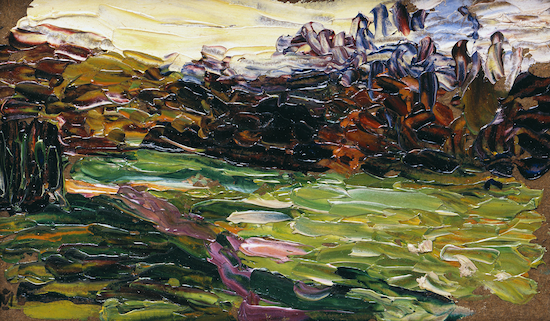 |
| Gabriele Münter, Countryside Near Paris, 1906, oil on board, 10 x 17 cm Brooklyn Museum, © 2026 Artists Right Society (ARS), New York (BMA-280mbars)
|
This little landscape is decidedly Fauvist in its color, but definitely Expressionistic in the brush work. Two years after this Münter took up the rustic German folk art of glass painting, which involved painting a scene from the top layer down on the underside of a piece of glass. This direct, simple method led to a simplification of form in her oil painting, as well as that of Kandinsky’s. While Münter encouraged Kandinsky’s progression towards complete abstraction, her own work never swayed from the objective. This painting comes from a group of works Münter painted in the countryside outside of Paris en plein air (in the open air, i.e. outdoors) with palette knife laying down layers of color over one another. Münter noted that the uncertainties of results when painting on the spot felt that it was akin to jumping into deep water not knowing if one could swim.
Background
Expressionism in northern European art of the early 1900s was an offshoot of art movements in the 1800s that emphasized romanticism, expressive color, or symbolic (rather than representational) subject matter. The objective in expressionist work was to express the artist’s feelings about the subject and to elicit an emotional reaction from the viewer.
German Expressionists built on the aims of Post-Impressionist artists who rejected the Impressionist emphasis on optical accuracy and turned towards the world of the spirit. They employed a variety of styles to give visible form to their feelings, often relying on direct, sometimes crude expressions. Their art was basically an expression of inner meaning through outer form.
Born in Berlin, Gabriele Münter first studied painting when she was twenty at a school in Düsseldorf for young women, since women were not allowed in German state academies. She was dissatisfied with traditional, academic painting and in 1901 enrolled in the Russian expressionist painter Vasily Kandinsky’s (1866-1944) Phalanx School in Berlin. In that school men and women were taught side by side. She and Kandinsky became close friends and they traveled Europe together between 1903 and 1908, a trip that included a two-year stay in France. In France they saw the work of the Fauves, the bright, jarring colors of which greatly influenced them.
On returning to Germany, she, Kandinsky and other artists settled in the Bavarian town of Murnau. The group of artists painted in similar, expressionist styles and encouraged each other. Unlike other expressionists in Germany who stressed pathos and the dark side of life, Münter and the other Murnau painters produced more lyrical works. Like other expressionists, they stressed the need for artists to express inner vision, but used jarring color, expressive line and form to relay content, rather than subject matter. Along with Kandinsky and Franz Marc (1880-1916) Münter formed the group Der Blaue Reiter, which was meant to promote expressionist painting.
Correlations to Davis programs: The Visual Experience 3E, lesson 7.2; Discovering Art History 4E, lesson 2.3; Davis Collections -- Women Artists 1900s

Comments