National Visit Your Relatives Day
What better way to observe this national day than by visiting family, such as these three adorable children (of ten) of the Lincoln family from New York state? Precious little is known about American women artists’ -- such as Susan C. Waters (1823-1900 US), whose birthday is 18 May -- training during the early 1800s, but there is no doubt that they were an active part of early American painting as far back as the early 1700s. The origin of National Visit Your Relatives Day is unknown.
May 18 is National Visit Your Relatives Day
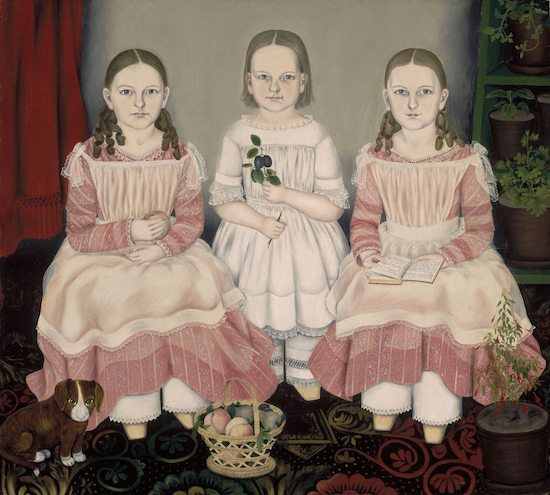 |
| Susan C. Waters, The Lincoln Children, 1845, oil on canvas, 114.9 x 127.6 cm © 2026 Museum of Fine Arts, Boston (MFAB-234)
|
Waters' earliest known work is a children's portrait of 1843. She painted many group portraits of rural families' children, such as this one of three of the ten children of Otis Lincoln, an innkeeper near Binghamton. Typical of many naive artists, physical detail of costume, objects and pattern take precedence over logical perspective, consistent light source, or volumetric interest. The room's perspective is arranged vertically, with the girls feet floating above it rather than planted on it.
On the other hand, the pyramidal arrangement of the figures establishes a strongly balanced composition that shows a sophisticated sense of design by Waters. The girls, Laura Eugenie, Sara, and Augusta hold attributes appropriate for young women: fruit (peach and plum) that symbolize sweetness, and an open book to symbolize diligence in their studies. Ironically, Waters gave up portraiture shortly after she painted this work, resurfacing as an artist some twenty years later specializing in still life and landscape paintings.
Background
Because there were no art academies in the colonies, most colonial painters were self-taught. There was no possibility of training in technique and anatomy in America. Some native American artists traveled to England to observe English painters. The early colonial style, based largely on prints of English portraits tended to be flat, evenly lit, and rich in realistic detail. Early portraits are characterized by unsophisticated draftsmanship, awkward rendering of anatomy, and emphasis on the luxury items of the sitter.
Despite the overwhelming influence of European, mostly English styles in art during the eighteenth and nineteenth centuries, the tradition of the itinerant, self-trained artist continued. These less-sophisticated artists provided a good source for patronage by less-affluent Americans who nonetheless wanted to demonstrate their refinement and good taste by commissioning art. Pockets of provincial, naïve art persisted through the nineteenth century in the form of segregated religious or Utopian communities, isolated frontier regions, and newly settled regions in the west.
As it was with itinerant artists during the Colonial period, portraiture was their main province during the first half of the 1800s. Susan C. Waters, born in Binghamton, New York, was active as a traveling artist across the New York/Pennsylvania border, eventually settling permanently in Bordentown, NJ in 1866.
Waters only known artistic training was at the age of 15 when she lived in a female seminary, the Friendsville (PA) Boarding School for Females. A Quaker, Waters was encouraged in her interest in painting by her husband. When his illness precluded working, Waters supported the couple with her painting, an unusual circumstance for a woman in early America. She also gave art lessons.
Correlation to Davis program: Explorations in Art 2E grade 1, lessons 2.1, 2.2; Explorations in Art 2E grade 2, lessons 2.1, 2.2; Explorations in Art 2E grade 3, lessons 1.1, 1.2, 1.4; Explorations in Art 2E grade 4, lessons 1.2, 2.1; Explorations in Art 2E grade 5, lessons 1.1, 1.7; Explorations in Art 2E grade 6, lessons 1.1, 1.2, 1.4; A Community Connection 2E lesson 2.1; A Global Pursuit 2E, lesson 6.4; A Personal Journey 2E, lesson 3.2; Experience Art, pp. 33-37; Discovering Drawing 3E, chapter 7; Exploring Painting 3E, chapter 10; Davis Collections -- Women Artists pre-1900s)

Comments