
Artist Birthday: Willem de Kooning (1904-1997 US, born Netherlands)
Abstract Expressionism, which developed in the 1940s primarily in New York, was the first original American modernism art movement. Willem de Kooning was one of the leading artists of this group, also known as the New York School.
Artist Birthday for 24 April: Willem de Kooning (1904-1997 US, born Netherlands)
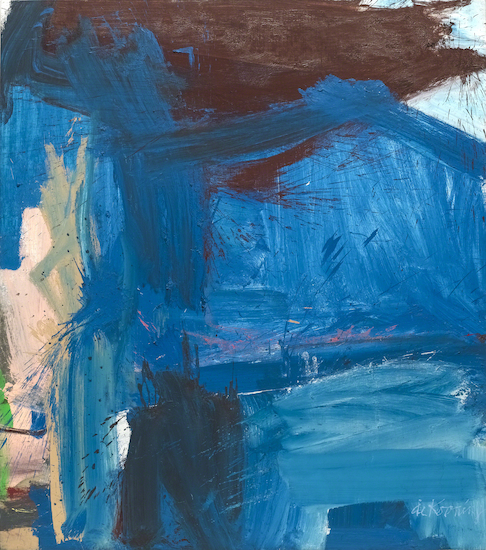 |
| Willem de Kooning, Tree in Naples, 1960, oil on canvas, 204 x 178 cm The Museum of Modern Art, New York, © 2026 The Willem de Kooning Foundation / Artists Rights Society (ARS), New York (MOMA-P2123kgars)
|
This work belongs to a group of abstractions inspired by the landscape. In them de Kooning simplified his visual vocabulary to a few powerful, expansive brushstrokes that evoke the vistas of color found in the natural world. He described the experience that inspired these works: “Just coming around roads, some place, and having the sensation of a piece of it, a piece of nature, like a fence, something on the road. And I really get very elated by again looking, by again seeing that the sky is blue, that the grass is green.” (Gallery label from Abstract Expressionist New York, October 3, 2010-April 25, 2011)
Despite the title indicating a view of nature, de Kooning's painting is very architectonic in structure, with a faint, grid-like construction visible especially in the cobalt blue passages. Although de Kooning's works may seem spontaneous and executed in the Surrealist-inspired "automatist" mode, de Kooning actually planned his paintings very carefully before starting them. Without preparatory sketches, de Kooning planned every brush stroke and what effect he wanted it to have. One can clearly see the artist's joy in nature in his reveling in the large swatch of cobalt blue, which may indicate his "epiphany" at seeing blue sky.
Background
Many of the pioneer European modernist artists fled to New York when World War II (1939-1945) in Europe broke out. This exposed American artists hungry for change from the prevalent Social Realism in American art to a wide variety of abstraction, and Surrealism. American artists, disillusioned by what they perceived as the failure of traditional values and systems in the war, sought new ways of expression. They rejected any realistic or nationalistic tendencies, as well as the sterile formalism of such abstractionists as Piet Mondrian (1872-1944). They were drawn to forms of abstraction that revealed individual expression, especially to the Surrealist work of Matta (1911-2000), who was in New York from 1939 to 1948. Matta introduced the New York artists to the idea of psychic automatism, creating from the subconscious. This would enable American artists to explore new forms.
By the mid-1940s, the leading artists of the New York school were exhibiting in galleries there. The Museum of Modern Art began acquiring their works, and in 1958 held a show called "The New American Painting." This show traveled to eight European countries, thus establishing for Abstract Expressionism (or, the New York School) an international reputation as a premier modernism movement. In 1948 several of the artists founded an informal school called "Subjects of the Artist." They were united in their belief that abstract art could express timeless, universal themes.
Willem De Kooning was one of the leaders of action painting. He was a central figure in Abstract Expressionism, even though he did not exhibit until 1948. Born in Rotterdam, he received a rigorous traditional painting education in the Rotterdam Academy. Before he moved to New York in 1926, he was a portrait painter.
In New York through the 1930s, he worked as a house painter, commercial artist, and Sunday painter, eventually becoming a full-time artist. During that time, his work gradually tended towards abstraction. His most important contacts were cubist Stuart Davis (1894-1964) and Gorky. With them he made frequent trips to the Metropolitan Museum of Art where he studied ancient art and old master paintings.
Like Jackson Pollock (1912-1956), de Kooning’s figurative work slowly took on cubist and expressionist aspects. By 1939 he produced landscapes that were reduced to solid color shapes, and portraits where the sitter’s face seemed to have been slashed out with the brush, a prefiguration of his Woman series. His mature style was a combination of cubist treatment of space, slashing expressionistic brushwork, and violent splashes of paint.

Comments