
Gem of the Month June: Art by Norman Foster (born 1935 Britain)
June 2 celebrates our Gem of the Month in London, and it also happens to be the birthday of the architect, Norman Foster. Foster’s designs greatly changed the skyline of London in the “modernization” of London after World War II (1939-1945). Foster has put a new spin on the “glass box” aesthetic of the International Style!
Gem of the Month for June: Norman Foster (born 1935 Britain)
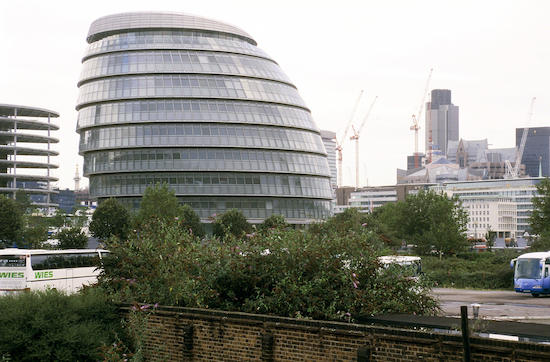 |
| Norman Foster, for Foster and Partners (firm London, 1967-present) New City Hall, London, completed 2002 Image © 2026 Ron Wiedenhoeft / Saskia, Ltd. (PBB-0009)
|
Norman Foster’s first big commission in 1970 — the Willis Faber and Dumas office in Ipswich, England — was an early indication of his status as a trailblazer in his redefinition of the International Style. The Ipswich building has a curving glass-clad façade that encloses a green atrium, which was a pioneering feature in its connection to nature in an urban environment.
New City Hall, situated next to Tower Bridge in London, is a landmark Foster design that not only redefines the glass box, but also government architecture as a whole. Unlike traditional municipal architecture with forbidding classical Greek façades and massive columns, Foster designed a glass bubble that expresses the ideal of transparency in city government. The sphere was modified geometrically using computer programs, and its design does not reveal an obvious front or back. A solid shape during the day, the building is transparent at night, revealing the graduated spiral ramp that spans all stories, much like Frank Lloyd Wright’s Guggenheim Museum in New York City.
Foster designed the building for transparency — the public can view chamber meetings in the glass-enclosed assembly hall on the ground floor. He also planned for optimum energy performance by minimizing the amount of surface exposed to direct sun. The south side of the building leans back so that the floors step inward to provide shade, while groundwater from the water table is used to service the cooling systems.
Background
British architecture was dominated by Classicism until World War II (1939–1945), with the exception of a few inroads made by Bauhaus and Art Deco influenced styles. The massive destruction of British cities during World War II, particularly London, spurred a boom in modernist architecture starting around 1950. The International Style arrived full force in the rebuilding of the British capital and endured into the 1970s.
In the mid-1970s, architects began to experiment with asymmetry, color, and incorporating historicist elements into their buildings. This rebellion against the sterile modernism of the International Style was called Postmodernism. By the 1990s, another group of artists began to challenge the prevailing functions, uses, and perceptions of architecture, generating a branch of Postmodernism that is often called Deconstructivism because it shatters the very foundations of standard geometric forms and seeks to create architecture as a kind of functional sculpture.
Norman Foster was born in Manchester and had an interest in structures and design from an early age. He also developed a keen love of drawing. He studied engineering while he was with the Royal Air Force before pursuing the study of architecture at the University of Manchester, England, and then at Yale University’s School of Architecture where he earned an MA in 1962. From his very earliest commissions, Foster transformed the International Style’s glass-box into thrilling Postmodern and Deconstructivist forms.
Correlations to Davis programs: Explorations in Art 1E, grade 1, lesson 1.1; The Visual Experience 3E, lesson 11.5; Experience Art, Unit 5 Place, lesson 5.3; Exploring Visual Design 4E, Chapter 10 Emphasis, Form

Comments